The Riga summit has finished, and President Bush flew to Jordan to talk with Prime Minister Nouri al-Maliki of Iraq. I will write a post on the consequence of NATO summit later on.
To my regret, Japanese politicians and the media pay little attention to this summit. As I mentioned in “NATO summit at Riga, Latvia”, this is an important conference for Japan, because NATO is exploring strategic partnership with liberal democracies out of the Atlantic region. Currently, Japan is assuming global role as witnessed in its quest for the permanent membership at the UN Security Council. NATO is globalizing rapidly. Both Japan and NATO share vital interests.
However, it seems to me that Japanese leaders do not care about this summit. Are Japanese politicians ready to share more burden as a leading member of the Western democracy? Those who read this post will understand why I am disappointed with politicians and opinion leaders in Tokyo.
Despite that, Prime Minister Shinzo Abe will visit NATO next January on his trip to Europe. To make Japan really a beautiful country as he says, active involvement in NATO is crucial. Politically speaking, Japan has two core foundations: Meiji westernization and postwar regime change. I hope the whole Japanese nation consider developing relations with Atlantic allies more seriously when Abe visits Europe.
Thursday, November 30, 2006


A Pause in NPO Procedure
As I mentioned previously in the post ”At Tokyo Metropolitan Government Office”, I have been trying to establish an officially accredited NPO. However, I had something private in October and November. Therefore, I had to cancel formal consultation with a Metropolitan official in charge of NPO affairs on November 2.
In order to found an accredited NPO, the general assembly for foundation must be held. Currently, many signatories live out of Tokyo. Some are too busy to attend the first general assembly. We shall appreciate contacts from Tokyo residents who are interested in our activities and values.
Thank you.
In order to found an accredited NPO, the general assembly for foundation must be held. Currently, many signatories live out of Tokyo. Some are too busy to attend the first general assembly. We shall appreciate contacts from Tokyo residents who are interested in our activities and values.
Thank you.
Wednesday, November 22, 2006
NATO Summit at Riga, Latvia

As I mentioned in a previous post, “NATO More Active on Global Security: From Brussels to Riga”, NATO summit will be held at Riga, the capital of Latvia on November 28th and 29th. This is a landmark of history from the following aspects. At this summit, leaders of Western democracies meet and talk vital issues on global security at the capital of a former Soviet republic. More importantly, NATO is expanding global commitment to tackle dreadful challenges in the 21st century, such as WMD proliferation, terrorism, and so forth. Despite the rift over the Iraq War, America and Europe are developing further cooperation for world peace and stability. The media talk so much about the impact of US midterm election on transatlantic relations, but it is meaningless.
At the Riga summit, leaders discuss the following issues: Afghanistan, Iraq, Darfur, terrorism, global activities, partnership with non-NATO members, and membership expansion. Nonetheless importantly, missile defense system will be an important agenda at this summit. This system is vital for some non-member states like Japan, as it faces increasing threat by North Korea. Also, NATO assumes increasingly global role. Therefore, NATO summit at Riga is beyond transatlantic security conference.
In order to talk of positive changes of NATO, I mention two articles in Foreign Affairs. One is “From Prague to Baghdad: NATO at Risk” in November/December 2002, by Strobe Talbott, Deputy Secretary of State under the Clinton administration and President at the Brookings Institution. The other is “Global NATO” in September/October 2006, by Ivo Daadler, Senior Fellow at the Brookings Institution, and James Goldgeier, Professor at George Washington University and Adjunct Senor Fellow at the Council on Foreign Relations. While Talbott saw the alliance pessimistically, Daadler and Goldgeiger see it more positively and assertively. Let me discuss changes, which reinvigorate the transatlantic alliance.
It was just before the Prague summit and the Iraq War when Talbott contributed his article. He was concerned with antipathy to the United States among European allies. The Cold War was over, and the Iraq War was about to start in a few months. Talbott commented the transatlantic rift in the following way.
But Prague will also highlight a paradox: NATO's long-term potential is virtually limitless, but its cohesion is at imminent risk. That is largely due to another paradox. The strength of the alliance has always derived from American power, which has never been greater, and from American leadership, which has never been more assertive. Yet these days many allies are feeling not so much led by the United States as bossed around; for them, the exercise of American power has become less a source of protection and more a cause of resentment and a problem to be managed.
Also, unlike leading Western policymakers today, he was skeptic to the idea of global NATO. In those days, NATO was expanding partnership with Japan, Australia, and New Zealand. It was beginning to act outside Europe. However, he said “That is largely because of the absence in those other areas of a militarily capable and politically respected defense pact that can create an environment conducive to cooperation and integration.” Furthermore, he said “However, that does not mean there will ever be, or should be, a global NATO that brings together representatives from the nearly 200 countries on earth, ranging from Afghanistan to Zimbabwe, arrayed around a table far larger than that in Brussels or anywhere else. If that happened, the alliance might as well merge with the UN General Assembly.”
Things have changed now. NATO has overcome bitter discord between both sides of the Atlantic on the Iraq War, and exploring further global commitment. In “Global NATO”, Daadler and Goldgeiger points out the following changes. In the war on terror, NATO has recognized that it is necessary to defeat remote enemy at their homelands. In addition, as US forces stretch thin in Iraq, European allies are beginning to fill the gap for global commitments. In August 2003, NATO decided to send the International Security Assistance Force (ISAF) to Afghanistan. Since then, NATO has been operating out of Europe, from Kashmir, Indonesia, to Louisiana. As NATO is evolving global, the alliance has begun to consider strategic partnership with nations sharing common liberal democratic values, like Japan, Australia, and New Zealand. Unlike Strobe Talbott, both authors welcome Secretary General Jaap de Hoop Scheffer’s suggestion that NATO become an alliance with global partners. Daadler and Goldgeoger insist, “Broadening membership is preferable to creating ad hoc coalitions.” Because “For one thing, European militaries are stretched thin by the many new missions they are called on to perform in Afghanistan and in Sudan, Congo, and other parts of Africa”, and “For another, formal membership would strengthen the ability of countries to work together in joint military operations.”
Finally, I would like to mention an interview with John Colston, Assistant Secretary General for Defence Policy and Planning of NATO. As briefly introduced on the web, he received degrees from Bristol and Oxford University, and worked for British Ministry of Defence for a many years. In the interview, he comments on critical issues for the future of NATO. As to NATO’s partnership beyond the transatlantic region, the following comments are noteworthy.
One of the key aspects of our working together with those countries is cooperation in defense reform. Partner countries are facing exactly the same challenges as NATO allies in terms of the threats of terrorism, the threats of proliferation, the threats of the 21st Century. And they face exactly the same challenges in adapting and modernizing their armed forces to meet those threats.
And as I've said, defense cooperation plays a very key part in that process. We are working with all these countries in terms of how best we can develop the ability of NATO nations and our partner nations to work together to confront terrorism, to confront the challenges of the 21st Century.
Those who are keenly aware of international politics cannot miss the Riga summit on 28th and 29th. Finally, I recommend readers to see Latvia Online Guide. This is a Latvian site, and onsite information will be available.
Thursday, November 16, 2006
Help Arrested Bloggers in Bahrain and Egypt
I received the e-mail from Rosemary of “My News’n Ideas” on November 8th. Her blog is linked to this blog. According to her message, HAMSA (Hands Across the Mideast Support Alliance) requests support for their activities to free arrested bloggers in Bahrain and Egypt. Please read the following message.
The freedom to say what you believe is a universal human right. But, as two prominent Middle Eastern bloggers discovered in the last week, freedom of expression is not always guaranteed. One blogger had his site blocked for text he posted. The other is currently in jail – and needs you help.
Mahmood Al-Yousif is known as the godfather of the blogging scene in Bahrain. A Bahraini entrepreneur, he runs a popular blog called Mahmood’s Den and serves as a judge for HAMSA’s Dream Deferred Essay Contest.
Last week, Bahrain’s Ministry of Information issued an order blocking Mahmood’s Den. They objected to his blogging about a recent scandal in Bahraini politics, and so suddenly readers in Bahrain could no longer access Mahmood’s blog. Along with a group of local activists, HAMSA launched a campaign to unblock Mahmood’s blog. Over 200 people sent emails to Bahraini officials.
A few days later – after negotiations with Mahmood – the site was unblocked.
One of the Middle Eastern bloggers who supported the campaign was Abdelkareem Soliman. Kareem, as he is also known, received international attention last year when he was kicked out of Al Azhar University in Egypt for criticizing the school on his blog.
Yesterday, Kareem was called into the prosecutor’s office in Alexandria, Egypt, where he lives. A lawyer from the Arabic Human Rights Network went with him. The Egyptian officials began interrogating Kareem about his blog, as well as his religious beliefs (“Do you fast on Ramadan? Do you pray? What do you think of things in Darfur?”).
Kareem stood firm. He would not retract anything he wrote on his blog. So the prosecutors threw Kareem in jail, where he remains as you read this. He faces several charges including "defaming the President of Egypt" and "highlighting inappropriate aspects that harm the reputation of Egypt." His case is currently on the front page of The Daily Star, one of Egypt’s largest independent English papers.
Kareem is a soft-spoken young man. He entered the HAMSA essay contest and joined a recent human rights seminar we recently organized in Cairo. We will not abandon him. And we hope you will take a moment to speak out on his behalf.
To stay updated on the campaign, read the Free Kareem blog started by his friends. And please take one minute to sign an email/petition to Egyptian and America authorities urging Kareem’s immediate release. In less than 24 hours, over 130 people have signed. Please add your voice. Thank you for your attention and support.
In Freedom,
Jesse SageHAMSA Project Director
You can participate in the campaign. Send them the link to this site:http://ent.groundspring.org/EmailNow/pub.php?module=URLTracker&cmd=track&j=105690869&u=1007093
I shall appreciate your support to this campaign.
Shah Alex
The freedom to say what you believe is a universal human right. But, as two prominent Middle Eastern bloggers discovered in the last week, freedom of expression is not always guaranteed. One blogger had his site blocked for text he posted. The other is currently in jail – and needs you help.
Mahmood Al-Yousif is known as the godfather of the blogging scene in Bahrain. A Bahraini entrepreneur, he runs a popular blog called Mahmood’s Den and serves as a judge for HAMSA’s Dream Deferred Essay Contest.
Last week, Bahrain’s Ministry of Information issued an order blocking Mahmood’s Den. They objected to his blogging about a recent scandal in Bahraini politics, and so suddenly readers in Bahrain could no longer access Mahmood’s blog. Along with a group of local activists, HAMSA launched a campaign to unblock Mahmood’s blog. Over 200 people sent emails to Bahraini officials.
A few days later – after negotiations with Mahmood – the site was unblocked.
One of the Middle Eastern bloggers who supported the campaign was Abdelkareem Soliman. Kareem, as he is also known, received international attention last year when he was kicked out of Al Azhar University in Egypt for criticizing the school on his blog.
Yesterday, Kareem was called into the prosecutor’s office in Alexandria, Egypt, where he lives. A lawyer from the Arabic Human Rights Network went with him. The Egyptian officials began interrogating Kareem about his blog, as well as his religious beliefs (“Do you fast on Ramadan? Do you pray? What do you think of things in Darfur?”).
Kareem stood firm. He would not retract anything he wrote on his blog. So the prosecutors threw Kareem in jail, where he remains as you read this. He faces several charges including "defaming the President of Egypt" and "highlighting inappropriate aspects that harm the reputation of Egypt." His case is currently on the front page of The Daily Star, one of Egypt’s largest independent English papers.
Kareem is a soft-spoken young man. He entered the HAMSA essay contest and joined a recent human rights seminar we recently organized in Cairo. We will not abandon him. And we hope you will take a moment to speak out on his behalf.
To stay updated on the campaign, read the Free Kareem blog started by his friends. And please take one minute to sign an email/petition to Egyptian and America authorities urging Kareem’s immediate release. In less than 24 hours, over 130 people have signed. Please add your voice. Thank you for your attention and support.
In Freedom,
Jesse SageHAMSA Project Director
You can participate in the campaign. Send them the link to this site:http://ent.groundspring.org/EmailNow/pub.php?module=URLTracker&cmd=track&j=105690869&u=1007093
I shall appreciate your support to this campaign.
Shah Alex
Friday, November 10, 2006
The Midterm Election and US Foreign Policy
In the midterm election on November 7, Democrats have won majority in both the Senate and the House. Just before this election, experts commented prospective impacts of election results on US foreign policy. For two years from now, the Bush administration will have some difficulty in dealing with the Congress. Iraq was the key issue in the election. Will President George W. Bush change his course in Iraq and foreign policy over all? Also, I would like to mention the impact on 2008 presidential election.
At the public forum sponsored by the Department of State on November 1, Thomas Mann, Senior Fellow at the Brookings Institution, said This election is being driven primarily by a very unpopular war in Iraq and secondarily by public perceptions of incompetence in the Bush administration and corruption in the Republican Congress. However, it is noteworthy that he said Given the angry public and narrow majorities in Congress, a failure by the Democrats to gain a majority in at least the House would raise troubling questions about the capacity of the American electoral system for democratic accountability. It would also be deeply dispiriting to congressional Democrats and probably lead to a raft of retirements. But it would not necessarily say much about the 2008 presidential election. There is no relationship between midterm gains and losses and the subsequent presidential election. That will depend on the broad political environment shaped by Iraq and the economy and the candidates nominated by each party. In other words, Democrats must show persuasive alternatives in both foreign and domestic policies. America faces numerous foreign policy issues, like terrorism, nuclear proliferation, Afghanistan, and so forth. Iraq is one of them, and none of other critical issues were discussed seriously in the election. Republican achievents are not necessarily bad.
For better or worse, Republicans must take responsibility for what the federal government has achieved during this period. And despite a buoyant economy, low unemployment and no significant terrorist attacks on American soil since September 11th 2001, most Americans think little has been done. (“Goodbye to the permanent majority?”, Economist, November 2)
Regarding post election foreign policy, Michael O’Hanlon, Senior Fellow at the Brookings Institution, talks of hard power Democrats, in his article “What is a Hard Power Progressive?” in the Daily Yomiuri on November 1. It must be more than someone who is a moderate on domestic policy and nothing but a conservative Republican clone on foreign affairs. Like Bush Senior and Bill Clinton, they will be more realist, and less inclined to trumpet American values than the current administration. It does not mean radical changes in US foreign policy. Hard power Democrats and similarly minded moderate Republicans should follow conservative and neoconservative focus on national security. Currently, the United States faces critical issues from Iraq to Iran to North Korea--not to mention a host of other key issues such as energy policy and the rise of China. Also, he argues as follows.
While being willing to criticize Bush for major mistakes in Iraq, such a hard-power Democrat or moderate should--unless absolutely convinced that we have already lost in Iraq--work hard to develop new ideas that give us some hope of salvaging a passable outcome in Iraq.
In conclusion, O’Hanlon insists that hard power Democrats will have a clear sense of how to blend hard and soft power into an effective mix that adds up to smart power for the new era and new challenges that so threaten the United States today.
Finally, I would like to refer to conservative viewpoints on this election and American foreign policy by three policy analysts at the American Enterprise Institute. Resident Scholar Joshua Muravchik criticizes Democrat leaders, Senator Harry Reid and Congresswoman Nancy Pelosi, as they do not show alternative ideas to the current administration. Another Resident Scholar Norman Ornstein foresees two changes after the election. One is through investigation on Iraq, torture, and intelligence failures. The other is congressional backlash against expansion of executive power. In addition to both comments, Vice President Danielle Pletka warns that rogue states and terrorists may be encouraged if they see America weak and divided. In any case, as long as Republicans hold executive power, they do not expect fundamental changes.
Real foreign policy debates start from now on. The media focus too much on “failure” in Iraq. But immediate withdrawal without sufficient consideration will not be of any help to stabilize Iraq. Moreover, America faces diversified global challenges. Which party can present true resolutions to manage these problems? The test for 2008 election has just begun.
At the public forum sponsored by the Department of State on November 1, Thomas Mann, Senior Fellow at the Brookings Institution, said This election is being driven primarily by a very unpopular war in Iraq and secondarily by public perceptions of incompetence in the Bush administration and corruption in the Republican Congress. However, it is noteworthy that he said Given the angry public and narrow majorities in Congress, a failure by the Democrats to gain a majority in at least the House would raise troubling questions about the capacity of the American electoral system for democratic accountability. It would also be deeply dispiriting to congressional Democrats and probably lead to a raft of retirements. But it would not necessarily say much about the 2008 presidential election. There is no relationship between midterm gains and losses and the subsequent presidential election. That will depend on the broad political environment shaped by Iraq and the economy and the candidates nominated by each party. In other words, Democrats must show persuasive alternatives in both foreign and domestic policies. America faces numerous foreign policy issues, like terrorism, nuclear proliferation, Afghanistan, and so forth. Iraq is one of them, and none of other critical issues were discussed seriously in the election. Republican achievents are not necessarily bad.
For better or worse, Republicans must take responsibility for what the federal government has achieved during this period. And despite a buoyant economy, low unemployment and no significant terrorist attacks on American soil since September 11th 2001, most Americans think little has been done. (“Goodbye to the permanent majority?”, Economist, November 2)
Regarding post election foreign policy, Michael O’Hanlon, Senior Fellow at the Brookings Institution, talks of hard power Democrats, in his article “What is a Hard Power Progressive?” in the Daily Yomiuri on November 1. It must be more than someone who is a moderate on domestic policy and nothing but a conservative Republican clone on foreign affairs. Like Bush Senior and Bill Clinton, they will be more realist, and less inclined to trumpet American values than the current administration. It does not mean radical changes in US foreign policy. Hard power Democrats and similarly minded moderate Republicans should follow conservative and neoconservative focus on national security. Currently, the United States faces critical issues from Iraq to Iran to North Korea--not to mention a host of other key issues such as energy policy and the rise of China. Also, he argues as follows.
While being willing to criticize Bush for major mistakes in Iraq, such a hard-power Democrat or moderate should--unless absolutely convinced that we have already lost in Iraq--work hard to develop new ideas that give us some hope of salvaging a passable outcome in Iraq.
In conclusion, O’Hanlon insists that hard power Democrats will have a clear sense of how to blend hard and soft power into an effective mix that adds up to smart power for the new era and new challenges that so threaten the United States today.
Finally, I would like to refer to conservative viewpoints on this election and American foreign policy by three policy analysts at the American Enterprise Institute. Resident Scholar Joshua Muravchik criticizes Democrat leaders, Senator Harry Reid and Congresswoman Nancy Pelosi, as they do not show alternative ideas to the current administration. Another Resident Scholar Norman Ornstein foresees two changes after the election. One is through investigation on Iraq, torture, and intelligence failures. The other is congressional backlash against expansion of executive power. In addition to both comments, Vice President Danielle Pletka warns that rogue states and terrorists may be encouraged if they see America weak and divided. In any case, as long as Republicans hold executive power, they do not expect fundamental changes.
Real foreign policy debates start from now on. The media focus too much on “failure” in Iraq. But immediate withdrawal without sufficient consideration will not be of any help to stabilize Iraq. Moreover, America faces diversified global challenges. Which party can present true resolutions to manage these problems? The test for 2008 election has just begun.
Tuesday, October 31, 2006
Robert Kagan vs. Thomas Freedman on the American Empire
A leading neoconservative Robert Kagan, Senior Associate at the Carnegie Endowment for International Peace, has published a book on the history of American foreign policy this month. He came back to Washington DC from Brussels to attend a panel discussion moderated by Thomas Freedman, editor of the New York Times, on October 18th at the Carnegie Endowment.
In his latest book “Dangerous Nation: America's Place in the World from Its Earliest Days to the Dawn of the 20th Century”, Kagan refutes the myth of America's isolationist tradition and insists that American foreign policy has been expansionist since its earliest days of the history. Currently, he is on leave for Brussels under a project of the German Marshall Fund. He sees America from Europeans’ viewpoint, and explores perception gaps on American between the United States and the rest of the world. Let me review the discussion. (See the video on Windows Media and Real Player.)
At the beginning of the panel, Kagan said that the nature of the government and the society define foreign policy of a country even more than external factors. American foreign policy is based on the Declaration of Independence, which advocates universal rights of all mankind. The key point of this is promotion of humanitarian liberal ideals. From its earliest days, American leaders have been pursuing this objective, from John Adams, Theodore Roosevelt, to Woodrow Wilson.
While American people regard their foreign policy altruistic, and driven by the noblest conceivable motives, the rest of the world sees it a dangerous, threatening, and destabilizing factor. Kagan mentions the US-Spanish Was in 1898 as a typical example. Though Europeans condemned American intervention to Cuba, Americans insisted this war a humanitarian and moralistic mission to liberate Cubans from Spanish colonial tyranny. The underlying nature of American foreign policy is expansionist and belligerent attitude, based on revolutionary character. However, Americans are not conscious of it, and they do not regard themselves as an empire. They do not admit their ambition and belligerence. This is a perception gap between America and the rest of the world.
Thomas Freedman asked whether there were other dangerous nations. Kagan said no nations were as revolutionary as the United States. China does not claim universal values. The British Empire was very close to the United States today, but it was based on ethnic nationalism. On the other hand, American nationalism is ideological one, which is based on the Declaration of Independence. Kagan argues that religion does not bind the United States, and it is utterly wrong to call it a Protestant nation or Christian nation.
An interesting example to illustrate the chasm between America and the rest of the world is the Monroe Doctrine. This is widely believed to be the symbol of isolationist foreign policy. In fact, the doctrine is an assertion of US foreign policy. It declares American dominance in the Western hemisphere and ideological superiority in the world.
In addition to ideological nationalism and altruistic expansionism, Kagan sheds light on the impact of the Civil War on US foreign policy. Before the Civil War, the United States made every effort to prevent slave uprising. The South feared another Haiti; a slave leader took place of white plantation owners. In terms of ideology, freedom and slavery are ambiguous. The result of the Civil War defines America’s ideological identity that liberal democracy prevails all over the world.
According to Robert Kagan, the Bush administration articulates basic values of US foreign policy that America is the special place in the world, and its power must be used for global progress. This trend has become more noticeable since 9/11. From normal America’s viewpoint, enemies like 9/11 terrorists, Japan, and the Soviet Union, attacked the United States because they were undemocratic. Therefore, American policymakers believe it necessary to change them, as they do not understand the ultimate truth that liberal democracy is universal.
The United States does not assume itself an empire, and US forces do not behave as occupiers in Iraq and Afghanistan. Unlike Lord Palmerstone in 19th century Britain, none of the American leaders admit their ambition for dominance. British historian Niall Ferguson, professor at Harvard University, criticize this attitude, and insists that the United States behave as the super power just as Britain did in the 19th century. However, Americans are unconscious of implicit meaning of their altruism: telling other nations to “become like us.” The rest of the world rejects such an idea.
Kagan points out vital aspects of American foreign policy. People in the rest of the world see America’s moralistic expansionism dangerous. This is important to understand anti-Americanism abroad as well. Both Britain and America prevail liberal ideals throughout the world. While Britain had no trouble in imposing their ways of thinking to its sphere of influence, the United States do not assume cultural superiority to others. Whether Republican or Democrat, we must always take it into account that fundamental chasm between America and the world will be inevitable. Can people of other civilizations live peacefully with the noblest mission based on the Declaration of Independence? This is one of the key issues in global security in this century.
In his latest book “Dangerous Nation: America's Place in the World from Its Earliest Days to the Dawn of the 20th Century”, Kagan refutes the myth of America's isolationist tradition and insists that American foreign policy has been expansionist since its earliest days of the history. Currently, he is on leave for Brussels under a project of the German Marshall Fund. He sees America from Europeans’ viewpoint, and explores perception gaps on American between the United States and the rest of the world. Let me review the discussion. (See the video on Windows Media and Real Player.)
At the beginning of the panel, Kagan said that the nature of the government and the society define foreign policy of a country even more than external factors. American foreign policy is based on the Declaration of Independence, which advocates universal rights of all mankind. The key point of this is promotion of humanitarian liberal ideals. From its earliest days, American leaders have been pursuing this objective, from John Adams, Theodore Roosevelt, to Woodrow Wilson.
While American people regard their foreign policy altruistic, and driven by the noblest conceivable motives, the rest of the world sees it a dangerous, threatening, and destabilizing factor. Kagan mentions the US-Spanish Was in 1898 as a typical example. Though Europeans condemned American intervention to Cuba, Americans insisted this war a humanitarian and moralistic mission to liberate Cubans from Spanish colonial tyranny. The underlying nature of American foreign policy is expansionist and belligerent attitude, based on revolutionary character. However, Americans are not conscious of it, and they do not regard themselves as an empire. They do not admit their ambition and belligerence. This is a perception gap between America and the rest of the world.
Thomas Freedman asked whether there were other dangerous nations. Kagan said no nations were as revolutionary as the United States. China does not claim universal values. The British Empire was very close to the United States today, but it was based on ethnic nationalism. On the other hand, American nationalism is ideological one, which is based on the Declaration of Independence. Kagan argues that religion does not bind the United States, and it is utterly wrong to call it a Protestant nation or Christian nation.
An interesting example to illustrate the chasm between America and the rest of the world is the Monroe Doctrine. This is widely believed to be the symbol of isolationist foreign policy. In fact, the doctrine is an assertion of US foreign policy. It declares American dominance in the Western hemisphere and ideological superiority in the world.
In addition to ideological nationalism and altruistic expansionism, Kagan sheds light on the impact of the Civil War on US foreign policy. Before the Civil War, the United States made every effort to prevent slave uprising. The South feared another Haiti; a slave leader took place of white plantation owners. In terms of ideology, freedom and slavery are ambiguous. The result of the Civil War defines America’s ideological identity that liberal democracy prevails all over the world.
According to Robert Kagan, the Bush administration articulates basic values of US foreign policy that America is the special place in the world, and its power must be used for global progress. This trend has become more noticeable since 9/11. From normal America’s viewpoint, enemies like 9/11 terrorists, Japan, and the Soviet Union, attacked the United States because they were undemocratic. Therefore, American policymakers believe it necessary to change them, as they do not understand the ultimate truth that liberal democracy is universal.
The United States does not assume itself an empire, and US forces do not behave as occupiers in Iraq and Afghanistan. Unlike Lord Palmerstone in 19th century Britain, none of the American leaders admit their ambition for dominance. British historian Niall Ferguson, professor at Harvard University, criticize this attitude, and insists that the United States behave as the super power just as Britain did in the 19th century. However, Americans are unconscious of implicit meaning of their altruism: telling other nations to “become like us.” The rest of the world rejects such an idea.
Kagan points out vital aspects of American foreign policy. People in the rest of the world see America’s moralistic expansionism dangerous. This is important to understand anti-Americanism abroad as well. Both Britain and America prevail liberal ideals throughout the world. While Britain had no trouble in imposing their ways of thinking to its sphere of influence, the United States do not assume cultural superiority to others. Whether Republican or Democrat, we must always take it into account that fundamental chasm between America and the world will be inevitable. Can people of other civilizations live peacefully with the noblest mission based on the Declaration of Independence? This is one of the key issues in global security in this century.
Tuesday, October 24, 2006
Managing North Korean Nuclrear Threat
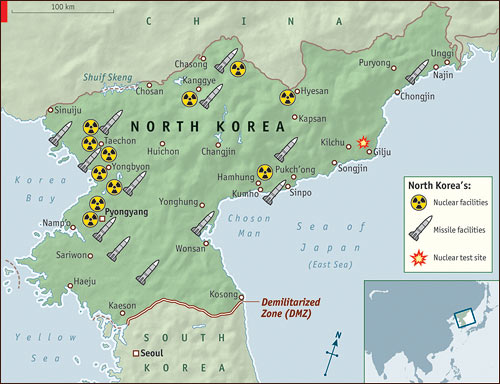
(Source: The Nightmare Comes to Pass, The Economist, October 12)
Secretary of State Condoleezza Rice visited the Far East to talk on North Korea’s nuclear bomb test. Prior to this trip, Marcus Noland, Senior Fellow at the Institute for International Economics answered seven questions in an interview with Foreign Policy this autumn. Let’s review the following questions and answers.
Question 1: What do you think the North Koreans hope to accomplish with this week’s test?
Noland says North Korean leaders believe nuclear possession guarantees the survival of their regime. The test is a step toward a nuclear weapons program.
Question 2: What is the significance of the timing?
The followings can be considered: Celebration of 10th anniversary of Kim Jong Il’s elevation to General Secretary of Korean Worker’s Party, Trying to upstage South Korean Foreign Minister Ban Ki-Moon’s selection as UN Secretary General, or Messing up Japanese Prime Minister Shinzo Abe’s visit to China.
Question 3: Is this an invitation for other countries to develop their nuclear programs?
Noland warns that this test could provoke further nuclear proliferation to the Far East, including Japan, South Korea, and Taiwan. In the same autumn issue, Foreign Policy evaluates the potential of nuclear proliferation to them in “The List: The Next Nuclear States.” The article analyses nuclear capability and motive of three countries.
Japan
Capability: Twenty-three tons of weapons-usable plutonium and the ability to produce weapons-grade uranium without much trouble. Japan has one of the world’s largest and most advanced civilian nuclear programs.
Motive: North Korea’s great leap may tip Japanese public opinion, and some politicians are calling for the country to debate openly whether it should have nukes.
South Korea
Capability: South Korea probably can’t produce weapons-grade nuclear fuel, despite having an advanced civilian nuclear sector. However, it secretly pursued nukes from the 1970s to as late as 2000. And it could always import technology from elsewhere.
Motive: North Korean military threat is growing seriously. With heightened U.S.-South Korea tension, Seoul has shown increasing interest in developing a defense capability independent of the United States. On the other hand, it may just wait to see whether it can inherit North Korea’s nukes through eventual reunification.
Taiwan
Capability: Until the late 1980s, Taiwan was within a few years of becoming a nuclear-armed state. Due to pressure from the United States and others, Taiwan now has no uranium enrichment capability, and plutonium handling facility. Its weapons-grade remnants are tiny. But its scientific know-how has probably survived.
Motive: Facing increasing military threat posed by China, Taiwan could decide that it needs nukes. Like North Korea, Taiwan can claim an existential threat from a superpower.
Leaders in East Asia must be cautious enough. American policy makers are beginning to see Far Eastern nations critically as they do against Iran and Syria. Readers would understand comments by Japanese foreign minister Taro Aso and Liberal Democratic Party’s policy chief Shoichi Nakagawa are imprudent. They talk of Japan’s nuclear option in public. Nuclear non-proliferation is a global agenda, and it is beyond narrowly scoped national interests. The Economist says as follows.
The spread of weapons of mass destruction is a clear threat to international peace and security. It remains to be seen whether tackling proliferation is something the world's big powers are ready to put ahead of their own rivalries. (See “Going Critical, Defying the World”, October 19)
Question 4: Is it more likely that fissile material would end up in the hands of a state or some organization like al Qaeda?
Noland says this is unlikely. It is difficult to transfer nuclear technology to non-state actors. Fixed location and fixed facilities are necessary, he says. But he does not rule out possible proliferation to terrorist groups.
Question 5: Will China follow through with meaningful sanctions?
Noland points out that China’s position to this issue is ambivalent, because it can use North Korea on the rivalry against the United States and India.
According to “The Nightmare Comes to Pass” in the Economist on October 19th, Professor Yan Xuetong at Tsinghua University says China is reluctant to escalate sanctions. Harder sanctions would lead North Korea to conduct more tests, he argues. Also, he says that China needs North Korea to assure its influence on the Korean Peninsula, and divert America’s attention from the Taiwan Strait. In Professor Yan's view, China's outrage at North Korea's test is similar to that of France and Germany over America's invasion of Iraq in 2003.
It is uncertain whether China impose meanigful sanctions against North Korea. In the same issue, the Economist argues critical points in “Sanctions: History Lessons.”
To be effective, it must be imposed by as many countries as possible. Particularly, China is the key actor. It must be smart, without hurting innocent people. Kim Jong Il does not care bad reputations abroad, and surrounded by yes-men. Therefore, “Increasing their isolation may be dangerous.”
True. Isolation from the world, this makes the North Korean issue more perplexing.
Question 6: If sanctions aren’t the appropriate approach, what should the international community’s response be?
Noland insists on using a “sanction card” to dissuade North Korea from testing another bomb. However, he worries that the North Koreans will eventually miscalculate and cross a red line where the United States acts militarily, whether South Korea likes it or not. Noland warns that appeasement can provoke North Korean adventurism.
Question 7: What’s next for North Korea?
China and South Korea are more concerned with turmoil in North Korea than nuclear threat. However, Noland says North Korea’s goal is to maintain the status quo, while accepted nuclear power status. Are China and South Korea united in dealing with the North?
“The Nightmare Comes to Pass” in the Economist on October 19th presents interesting analysis on Sino-Korean relations. China worries that a united Korea would stimulate nationalism and anti-Chinese sentiment throughout the peninsula. Many Koreans suspect China’s ambition to dominate Korea as a buffer against Japan. Historically, Korea subjected to China. This chasm between China and South Korea needs to be noticed.
Now, I have reviewed seven questions. Since then, North Korea promised to stop further nuclear test. But it is not certain how long the autocrat keeps silent. In any case, he has tested a nuclear weapon. Its impact on Iran cannot be dismissed. Eventually, current regime in North Korea must be thrown away through assisting domestic uprising, I believe.
Subscribe to:
Posts (Atom)