Friday, April 24, 2020

Russia’s Constitutional Amendment and Foreign Policy


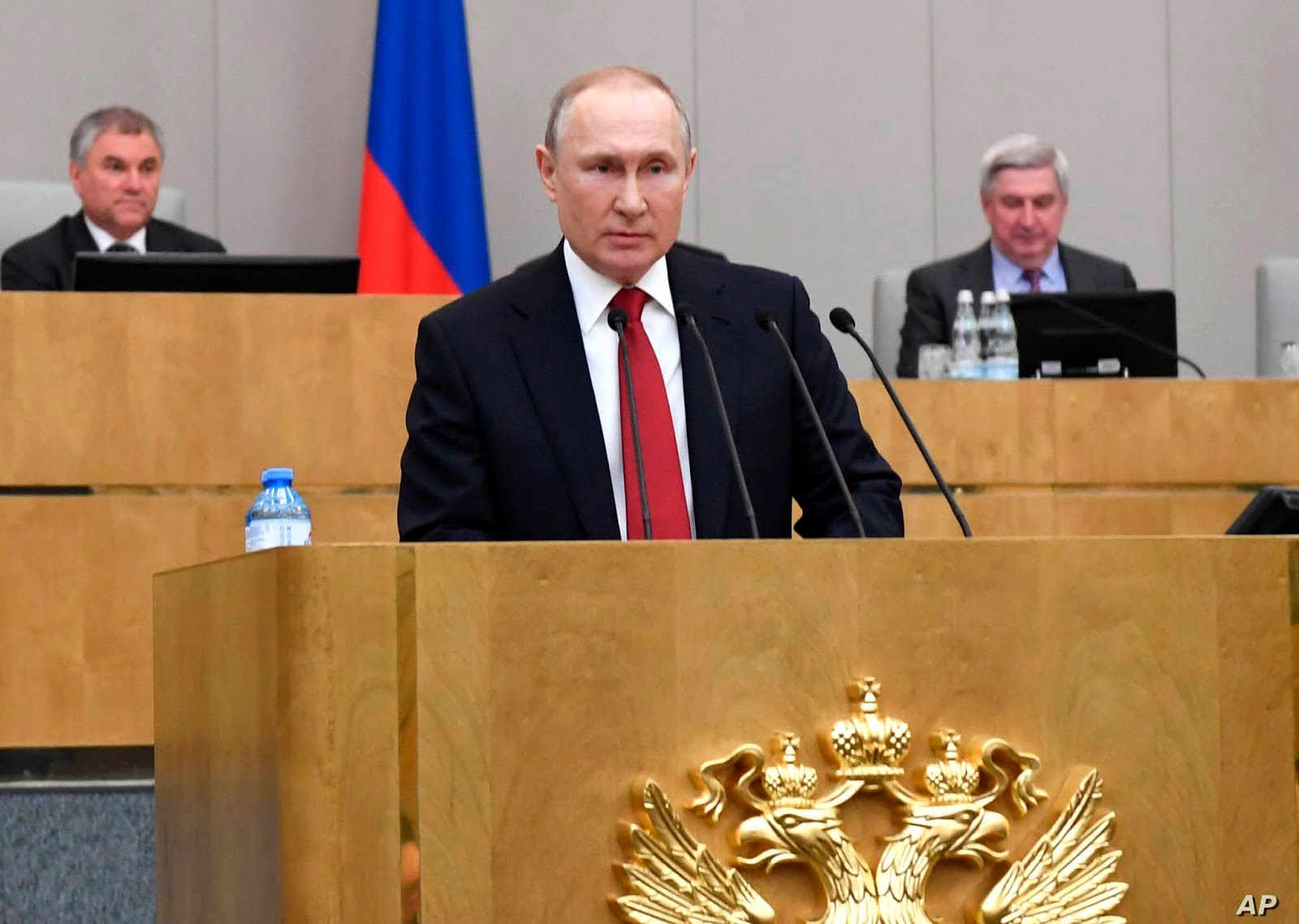
Russian Duma and the Constitutional Court approved the constitutional amendment by President Vladimir Putin last March (“Russian Lawmakers Adopt Putin’s Sweeping Constitutional Amendments”; Moscow Times; March 11, 2020 and “Russia's constitutional court clears proposal to let Putin stay in power beyond term limits”; ABC News; 17 March, 2020). Much attention was drawn to Putin’s presidential term and his status after the amendment. However, I would like to mention furthermore, which is the impact of this amendment on Russian foreign policy. Putin’s nationalist diplomacy is closely intertwined with his domestic traditionalism of tandem rule with the Russian Orthodox Church. I would like to explore how will Putin advance Russian presence in the world through this amendment.

To begin with, I would like to mention ideological resonance with the Western far right. Through the experience of post-Soviet confusion, Putin had become highly alert to socio-cultural and geopolitical challenges of Western liberalism to Russia. His return to Russian Orthodox traditionalism to overcome such political anomie is highly applauded by White Christian nationalists in Europe and North America, because they are also dismayed with liberal globalism. They believe in common Christian traditions with post-Soviet Russia. Quite importantly, Putin’s constitutional amendment mentions faith in god and straight marriage, based on Russian Orthodox values (“Russia's Putin wants traditional marriage and God in constitution”; BBC News; 3 March, 2020). But that is a complete infringement of the principle of the modern nation state, that is, separation of church and state. Fundamentally, it echoes with the argument of the Christian Right-wing in the United States, who demands the Genesis creation narrative of the Bible be taught at school, rather than the theory of evolution.

Putin’s czarist Christian value was put into practice soon after the corona outbreak. Russia provides an extensive corona aid to Italy. The Kremlin seizes this opportunity to boost their influence in this country. Geopolitically, Italy has been the soft belly of NATO, since the Cold War era. The Communist Party in Italy was the largest in Western Europe, and she had close economic ties with the Soviet Union to import oil and to build a car factory there. Even after the fall of the Soviet Union, such strong ties continue. Whether far right or far left, Italian populists have been dissatisfied with strict European standard of transparency of governance, thus, they are willing to embrace Russia and China, rather than their fellow EU nations and organizations (“With Friends Like These: The Kremlin’s Far-Right and Populist Connections in Italy and Austria”; Carnegie Endowment for International Peace; February 27, 2020).

Particularly in the north, the Lombardy-Russia Cultural Association, which is sponsored by a Russian Christian ultra-rightist Alexey Komov, who is deeply associated with the American far right organizations, including the WCF (World Congress of Families) and the NRA, serves as the gateway of Russian influence (“A major Russian financing scandal connects to America’s Christian fundamentalists”; Think Progress; July 12, 2019). As if in consort with the Kremlin, Hungarian Prime Minister Victor Orbán seized the opportunity of the corona crisis to suspend the parliament and cement his dictatorship furthermore (“Orbán Exploits Coronavirus Pandemic to Destroy Hungary’s Democracy”; Carnegie Endowment --- Strategic Europe; March 31, 2020). In view of those actions of Putin’s Russia and European far right, the corona outbreak accelerates the power game before the incident, rather than changing the framework of international politics completely.

In addition, the proposed amendment defies international norms. It states that domestic law is superior to international law. In practice, Russia has violated international law, such as invading Georgia in 2008, annexing Crimea in 2014, and frequent human rights abuses at home. Also, the Kremlin has not been committed to trade liberalization since joining the WTO in 2012. However, this amendment sends a clear message to Putin’s domestic supporters that Russia stands firmly against the West (“Russian law will trump international law. So what?”; AEIdeas; January 16, 2020). Putin also proposes a ban on territorial cession, which would complicate the relationship with Russian neighbors, particularly, with Japan and Ukraine (“Putin wants constitutional ban on Russia handing land to foreign powers”; Reuters; March 3, 2020).

It is quite likely that these amendments are based on sovereign democracy, which is advocated by Vladislav Surkov, the closest advisor to Putin. The fundamental idea of this ideology is that democracy in Russia is deeply rooted in her sovereignty and cultural tradition, thus, the West should not interfere in domestic issues like human rights and checks and balances (“Putin's "Sovereign Democracy"; Carnegie Moscow Center; July 16, 2006). Open Democracy comments that it is not an intellectually inspiring ideology, and just a propaganda (“'Sovereign democracy', Russian-style”; OpenDemocracy; 16 November, 2006). Interestingly, Surkov’s sovereign democracy resonates with Yoram Hazony’s nationalist democracy among the Western far right, which influences the thoughts of some Trump staff of the United States, notably, Secretary of State Mike Pompeo and Acting DNI Richard Grennell, who was the Ambassador to Germany until quite recently. Therefore, Putin’s constitutional amendment poses critical implications globally, much more than commonly understood. Meanwhile, the national referendum on this constitutional amendment, that was scheduled on April 22, was postponed, because of the corona crisis (“Kremlin Mulls Date for Post-Virus Vote on Putin's Constitution Reform”; Moscow Times; April 22, 2020). It is not clear how much it delays Putin’s foreign policy schedule.

Friday, March 20, 2020

US Presidential Election and the Middl East


It is anticipated that the rapid increase of shale oil and gas production could accelerate American isolationism and disengagement from the Middle East. History tells us that isolationism is not viable, despite energy self-sufficiency. Shortly before the United States joined the Allied Forces, her industrial and mining output was overwhelming, producing 60% of world oil output (“Timeline: Oil Dependence and US Foreign Policy”; Council on Foreign Relations). Americans were barely awakened by the Pearl Harbor attack. Obviously, they underestimated savage power interactions of international politics, in those days. Even if the United States is totally disengaged from the Middle East, the mindset among adversary regimes and terrorists shall not change. They educate the youth to blame that the “axis” of the United States, Britain, and Zionists, is responsible for the misfortune of their fellow Muslims. This bigotry has been inherited for generations. Disengagement from this region would just prompt another Pearl Harbor or 9-11 terrorist attacks.

In the midst of the presidential election campaign, the Council on Foreign Relations sent a questionnaire to the candidates about foreign policy. 4 out of 12 questions are Middle East issues, such as, the nuclear deal with Iran, withdrawal from Afghanistan, the murder of Kashoggi by Saudi Arabia, and the peace talk between Israel and Palestine. Voters may be fed up with long wars in the Middle East, but for foreign policy experts, this region is still strategically important. Remember that the Middle East has been the crossroads of civilizations and great power rivalries for centuries. Among the four questions, Afghanistan is the most imminent.

At the end of last February, Donald Trump announced that he made a peace deal with the Taliban to pull out troops from there. Appallingly, Trump has kept his election promise so indiscreetly, to conclude this “Make Taliban Great Again” deal. The United States will create the power vacuum through withdrawing forces in just 14 months, and also, release Taliban terrorists from the prison. Ultimately, that will reinvigorate them (“President Trump's Disgraceful Peace Deal with the Taliban”; Time; March 3, 2020). Furthermore, Trump repeats Barack Obama’s mistake in Middle East policy to withdraw troops from Iraq and Syria prematurely, and Bill Clinton’s mistake in Afghanistan. In 1997, the Clinton administration expected the Taliban to stop sponsoring terrorism, in return for an oil pipeline project in their realm, but that deal failed to prevent the 9-11 attacks. Trump’s deal with the Taliban is similarly dangerous (“Trump’s bad Taliban deal”; Washington Examiner; February 27, 2020). How dare can he blame Democrats?

To prevent another 9-11 attacks, the United States need to engage with the Afghan government continually, through development aid (“The Riskiness of the U.S. Deal to Leave Afghanistan”; Council on Foreign Relations; March 2, 2020). Richard Haass, President of the Council on Foreign Relations, argues furthermore, that the United States conclude a more detailed security pact with the Afghan government separately, regarding the conditions of troop withdrawal and long-term support for them, from economic development to national security. That would assure the continual US presence in Afghanistan (“How Not to Leave Afghanistan”; Project Syndicate; March 3, 2020). Afghanistan has been dependent on US brokering to conclude the results of presidential election since the overthrow of the Taliban, partly because the Afghan constitution assumes unitary rule of the president, while the nation is actually fragmented by tribes and warlords. They do not accept the results straightforwardly (“Afghanistan’s Election Disputes Reflect Its Constitution’s Flaws”; Carnegie Endowment for International Peace; March 12, 2020).

While rival candidates tell almost unanimously that Trump respect multilateralism and American moralism, on the Iran nuclear deal, Saudi Arabian human rights, and the Israeli-Palestine peace talk, they do not show compelling ideas to refute his irresponsible retreat from Afghanistan. It seems that American leaders and public have no articulate vision of post-911 Middle East yet. Among the candidates, Bernie Sanders is obsessed with an antiwar leftist vision to blame the military-industrial complex and oil business for America’s long wars in the Middle East. That is just another kind of America First. Voters may not be interested in Afghanistan, but the Democrat needs to show a strong alternative to Trump’s way.

Besides those four questions of the CFR questionnaire, Republican Bill Weld, who runs against Trump, replies to the question on Africa in connection with Middle East terrorism, while other candidates simply mention development aid and empowerment. Actually, the Middle East is deeply intertwined with other foreign policy issues. Some people say that the United States focus more on Asia to curtail rising threats of China. But I would argue that the return of American internationalism is more vital than America’s strategic emphasis by region. Disengagement from the Middle East is still reckless and premature.

Friday, January 31, 2020

The Ambiguity of the Indo-Pacific Strategy


At the end of the last year, I had some opportunities to attend a couple of public forums on the Indo-Pacific strategy to defend the freedom of navigation and the rule of law in this huge region. Literally speaking, the Indo-Pacific region means the area beyond the east of Suez, but policy debates focus on managing Chinese expansionism in the South China Sea so much that it seems to me that this grand design is confused with, or even contract into the Asia-Pacific strategy. That may be why most of the debates sound rather reactive to Chinese expansion, than proactive to take an initiative for the new order in this region. Therefore, I would like to review the background of the Indo=Pacific strategy from the beginning.

The genesis of the Indo-Pacific strategy today was presented by Japanese Prime Minister Shinzo Abe at the TICAD (Tokyo International Conference on African Development) Nairobi in 2016. Abe stressed importance of the sea lane that connects Asia and Africa, and stated that Japan would endorse freedom of navigation and the rule of law for African development and security ("Address by Prime Minister Shinzo Abe at TICAD VI"; Ministry of Foreign Affairs, Japan; August 27, 2016 and TICAD Yokohama Declaration states the "Indo-Pacific Initiative"; Nihon Keizai Shimbun; August 30, 2019).Abe’s idea is nothing new. Historically, there were some precursors. In the Middle Age, Arab-Muslim merchants dominated trade of goods and slaves from Africa to the Far East on the sea. In the colonial era, the British Empire defended the sea lane from Suez to Singapore, Hong Kong, and Shanghai. Also, the Royal Navy enforced the rule of law to stop slave export from Africa. More recently, the Bush administration launched the Greater Middle East Initiative to fight the War on Terror against Islamic extremism, and to promote democracy throughout the region.

Compared with these historic precedences, it seems to me that current Indo-Pacific strategy lacks panoramic views and consistency. China is a critical challenge, but I would argue that it is necessary to manage threats in the Middle East and Africa like Iran and terrorism, in connection with Chinese geopolitical ambition. Also, we need to consider the multilateral framework for this objective. Actually, Professor Ken Jimbo of Keio University comments that America’s Pacific strategy had evolved virtually into the Indo-Pacific strategy, when the 7th fleet began to fill the vacuum in the Indian Ocean after British withdrawal from the east of Suez in the 1960s and 70s. Nevertheless, we witness how the Western strategy against Iran is poorly coordinated these days. In view of such multidimensional aspects, let me talk about the involvement by regional stakeholders beyond the Asia-Pacific.

Just as Asia-Pacific nations have different interests and priorities each other, so do the nations of the Indian Ocean. Most noticeably, India wants to maintain strategic autonomy from the United States, though she assumes China as the primary threat in her “Look East” defense strategy. Meanwhile, African nations wonder how much they can embrace China’s BRI. While they do not want the West to preach democracy and human rights, some countries like Kenya worries that China would dominate them through 5G telecommunication systems and tied aid, and even drag them into East Asian conflicts in which they are hardly interested (“Focus: the Potential of the Indo=Pacific Initiative”; JIIA International Affairs; December 2019). Also, we have to accommodate major powers outside the region into the Indo-Pacific strategy. From this point of view, US-European partnership is quite important. However, as President Donald Trump courts conservative base at home to prioritize his reelection to diplomacy, the transatlantic clash of values over new human rights, such as abortion rights and LGBTQ issues, grows further. Secretary of State Mike Pompeo mocks them “unreliable rights” ("The Case for Transatlantic Cooperation in the Indo-Pacific"; Carnegie Endowment for International Peace; Decomber 18, 2019).

As policy coordination among allies stall, another challenger to the Indo-Pacific strategy emerges. Strobe Talbott of the Brookings Institution, comments that Russian influence in the Middle East is growing, while America and Europe split over Iran (“The only winner of the US-Iran showdown is Russia”; Brookings Institution; January 9, 2020). Abe has launched an ambitious initiative to show Japanese political presence in the absence of American leadership. But today, everything has become more complicated than in the days of Arab traders and British imperialists, to implement a grand design to connect Africa and Asia that Abe stated at the TICAD 6 in Nairobi. On one hand, we have to manage specific and imminent problem like Chinese expansionism, but on the other hand, we have to review the concept of the Indo-Pacific strategy in the whole region.

Monday, December 23, 2019

Further World Disorder by Trump’s Hazonian Nationalism


Quite paradoxically, nationalism can make the nation mediocre in the world. Currently, populist nationalism of US President Donald Trump turns out caustically divisive in domestic politics. On the global stage, it could invigorate micronationalism, and fragment the nation state and regional organizations. Eventually, that could enfeeble American allies and the United States itself. Earlier this year, former Deputy National Security Advisor Michael Anton explains Trump’s foreign policy criteria as an insider of the administration (“An insider explains the president’s foreign policy.”; Foreign Policy; April 20, 2019).

Apparently, Trump is not neoconservative, nor is he paleoconservative. According to Anton, his foreign policy viewpoints do not fit into any ideological categories, but his America First slogan comes from homing instinct, which is naturally embedded in human minds. It seems that Anton assumes properly on this point, because a populist like Trump do not express his ideas in sophisticated notions. For further understanding, this article describes Trump’s foreign policy thorough applying the argument of an Israeli political philosopher Yoram Hazony, who is the author of “The Virtue of Nationalism”. Hazony did not invent the Trump phenomenon, but he provides theoretical foundations for far right populism in the West.

Hazony contrasts the notion of polis and empire in accordance with Aristotle’s “Politics”. A polis consists of homogeneous ethne, which means “ethnic” in English. He argues that “polis” is founded on communitarian instinct, which he mentions “love of one’s own”, and that reinforced self-motivated patriotism among polis citizens such as Athenians and Spartans. Anton applies his theory to justify Trump’s America First foreign policy, “Make America Great Again”. On the other hand, an empire is a heterogeneous polity of universalism. He mentions historical fallacy of the Achaemenid Persia and Rome, through the work of Xenophon, Machiavelli, and Montesqieu. In his view, multi-ethnic empire is so huge that it needs an extensive scale of armed forces and secret police networks to maintain the order, which makes its polity repressive. Likewise, he says, current globalization and regional integration alienate the human nature to “love of one’s own” ethne.

The problem is ethne can be defined broadly or narrowly, depending on preference. Alexander the Great defined it broadly, when he started the war against Persia, and his Hellenes were the whole Greeks, including Macedonians. On the other hand, micronationalists today define it narrowly. We have to bear in mind that since the modern nation state is not so small and homogeneous as Greek polis, their interpretation of this word can provoke fragmentation of one country, and inflict negative impacts on national and global security.

Among such micronationalist movements, the most critical one is in Scotland. Regretfully, Brexit is accelerating the trend for Scottish independence. However, Scotland is a strategic zone for British national defense. The Royal Navy is critically concerned whether Faslane nuclear submarine base and shipyards in Glasgow and Rosyth will be continually available, if Scotland were to leave the United Kingdom (“Leasing Faslane could generate £1bn a year for an independent Scotland”; UK Defence Journal; August 19, 2019 : “First Minister claims independent Scotland still eligible for Royal Navy work”; UK Defence Journal; November 22, 2019 : “Would UK naval shipbuilding continue in Scotland if it left the UK?”; UK Defence Journal; December 16, 2019). Also, Scotland is the northern front line to stop Russian intrusion from the air and the sea. Tory rightists in England are so NIMBY minded that they are excessively obsessed with EU regulations and cheap labor immigrants.

Similarly, Okinawa may rise against Japan to shed the burden of accommodating US military bases. An independent Okinawa would be a huge hurdle to implement US strategy in the Indo-Pacific region. Moreover, America itself is not immune from the peril of fragmentation. If Trump were to be reelected, California could leave the United States. Also, if the Western far right were to pursue Hazonian nationalism so irresponsibly, it could weaken the whole of the Western alliance, and ultimately, ruin their national interest.

In view of this, we have to reexamine the real meaning of Secretary of State Mike Pompeo’s case for freedom in Hong Kong, Uyghur, and Tibet. Earlier this year, Robert Kagan of the Brookings Institution pointed out that his democracy is based on Hazonian nationalism, not Lockean liberalism, and that is not compatible with long-held Wilsonian universalism of US foreign policy (“The strongmen strike back”; Brookings Institution; March, 2019). From this point of view, we can surmise why Pompeo attacks China, while he is tolerant of human rights abuses in Russia, Saudi Arabia, and Turkey. It is likely that he sponsors micronationalism in China to fragment America’s formidable industrial and geopolitical rival. Therefore, it is naïve to assume him reliable for Asian allies, simply because he is a China hawk. Remember, Europeans do not see him so favorably.

Quite interestingly, Anton complains in his article that multilateral frameworks in Europe like NATO and the EU deter America First foreign policy, while nothing does in Asia. Today, the clash between Hazonian nationalism of Trump and his populist followers, and universal liberalism of Western élites and worldwide globalists shakes international politics.

Sunday, December 01, 2019

Trump Really Begins to Abandon American Hegemony from Syria


The global community was startled to hear that President Donald Trump would withdraw US troops from Syria, and abandon the Kurds, who have been a long time ally for the United States in the Middle East. This implies that Trump has begun to carry out his outrageous election pledge to scale down America’s security commitment on the global stage. Quite importantly, Trump’s America First actions go beyond Syria. Now, it has become clear that his corrosive words are not for a poker game, and he is really abandoning American hegemony, so irresponsibly.

To begin with, let me talk about geopolitical retreat from Syria. Bitter backlashes came from Democrats and even from Trump’s fellow Republicans, as they are critically concerned with the geostrategic advancement of Russia and Turkey, and the resurgence of ISIS, following the power vacuum. Also, that is partly because Syria is not an election issue (“Why did Trump betray the Kurds? The rationales make no sense.”; Washington Post; October 10, 2019). The most fundamental mistake is that Trump confuses “endless war” in the Middle East with open ended military presence to maintain the alliance network, according to Richard Haass, President of the Council on Foreign Relations. In other words, Trump’s America First pledge is based on misguided assumptions (“The High Price of Trump’s Great Betrayal”; Project Syndicate; October 17, 2019). Ironically, Trump makes the same, or even worse mistake than his Democratic predecessor did. As to this, Max Boot comments the following. In 2011, President Barack Obama rejected to intervene to stop Syria from using chemical weapons against the opposition until Assad crosses the Red Line, though Secretary of State Hillary Clinton, CIA Director David Petraeus, and Senator John McCain in those days argued for military aid to the rebels, and creation of safe zones and no-fly zones. That was simply for fear of another Iraq quagmire. But Obama failed to deter Assad from crossing the line, and reversed his Syria policy to support the Kurds, later. In view of this, Boot criticizes there is nothing legitimate, regarding Trump’s abandonment of the Kurds, as it simply invigorates Turkey and Russia (“Obama’s Syria policy was bad. Trump’s is worse.”; Washington Post; October 22, 2019).

In addition to geopolitical supremacy in the Middle East, Trump is damaging the universal legitimacy of American values. The Trump administration dismisses broadly shared understandings of Kurdish-Turkey relations among foreign policy communities. Syrian Kurds are closely tied with the PKK in Turkey. Despite communist backgrounds in the past, the PKK today is regarded as a freedom fighter group like the ANC in South Africa, among Middle East democratization experts, such as Michael Rubin at the American Enterprise Institute (“It’s time to acknowledge the PKK’s evolution”; National Interest; January 25, 2019). On the other hand, Secretary of State Mike Pompeo agrees with Recep Erdoğan that the PKK is a terrorist group, and defends Turkey’s incursion, from his Hazony-styled nationalist point of view (“Turkey had ‘legitimate security concern’ in attacking Syrian Kurds, Pompeo says”; PBS News Hour; October 9, 2019). Therefore, the Trump administration treats Syrian Kurds bluntly, even though they helped America’s war on terror a lot, which faced bitter bipartisan criticism in the Congress.

Trump’s abdication of geopolitical responsibility and “quid pro quo” nationalism has led to an inevitable clash with American allies. In the Middle East, Israel realized that Trump was as reluctant as Obama to stand up against threats like Iran and so forth (“After Trump abandons Kurds, Israel knows it can’t rely on anyone”; Jerusalem Post; October 7, 2019). His Evangelical base is nothing reliable, when Israeli security is critically tested. More importantly, the trans-Atlantic rift is growing terribly. It is not just a resurgence of terrorism and the influx of refugees that terrifies Europeans, after American withdrawal from Syria. Garvan Walshe, former national and international security advisor of the British Conservative Party, comments that Trump’s abandonment of the Kurds is a notice to tell Europeans that those who depend on America’s security umbrella at present can choose either serve for Trump’s personal interests like Ukraine’s Zelensky, or act on their own, which chilled the spine of Poland, Latvia, and Lithuania (“Kobani Today, Krakow Tomorrow”; Foreign Policy ---- Argument; October 16, 2019).

The isolationist policy that arises from the Syrian fiasco inflicts tremendous damages beyond the Middle East and Europe. In Asia, Trump skipped the East Asian Summit, this November. He does not give consideration to strategic rivalries with China (Twitter: Ely Ratner; October 30). Furthermore, he even suggested withdrawal of US troops from South Korea, as defense cost talks did not make progress, which upset Defense department officials (“Pentagon denies report U.S. mulls pulling up to 4,000 troops from South Korea”; Reuters; November 21. 2019). Meanwhile, the Defense Intelligence Agency released a report to assess that ISIS would rise again in Syria in the long term, even though the US troop killed the leader Abu Bakr al-Baghdadi successfully (“Trump's pullout from Syria allowed ISIS to gain strength, intel agency reports”; Politico; November 19, 2019). After all, Trump has fired the adults in the room, and hurdles against implementing his America First election pledge have been removed. If he were to be reelected, it would be catastrophic for the global community. In that case, American allies and foreign policy makers would have to work totgether to explore the damage control against his words and deeds.

Thursday, September 26, 2019

The trans-Atlantic Chasm Undermines the US-Japanese Alliance

It is commonly assumed that the US-Japanese alliance is a security partnership in the Pacific region, but I would like to see this strategic linchpin from the Atlantic side. For this purpose, I would like to mention Secretary of State Mike Pompeo’s address at the German Marshall Fund in Brussels, when he attended NATO foreign Ministers Meeting last December. His Trumpian speech dismayed Europeans. He flatly denied world peace by multilateralism and regional cooperation, which saved Europe from antagonistic great power rivalries before World War II. Moreover, he stated that the EU was a polity of multinational bureaucracy, at the expense of sovereign nations and citizens (“Secretary of State Michael R. Pompeo at the German Marshall Fund, Brussels, Belgium”; US Missions to International Organizations in Vienna; December 4, 2018). Pompeo’s remark is widening the trans-Atlantic chasm so critically that the foundation of the liberal world order is increasingly at risk today.

The Brussels speech is graded negatively among American foreign policy experts as well. Robert Kagan at the Brookings Institution, comments that Pompeo’s speech resonates with Israeli far right scholar Yoram Hazony, as he said democracy was based on nationalism, not liberalism (“The strongmen strike back”; Brookings Institution; March 2019). Stewart Patrick of the Council on Foreign Relations criticizes his “principled realism” more harshly. While Pompeo attacked multilateral organizations that the United States has endorsed or created, like the EU, the UN, the World Bank, and the IMF, he did not mention how much the Trump administration had eroded America’s reputation among allies. Contrary to Pompeo’s understanding that multilateralism has augmented excessive burden of bureaucratic procedures, and restricted sovereign actions of US diplomacy, Patrick argues that multilateral cooperation has been mutually beneficial, and helped American supremacy on the global stage. Regarding the EU, he refutes Pompeo’s poorly founded view about national sovereignty, because member states have the most powerful leverage in the decision making of the Union. Likewise, Pompeo is wrong about other international organizations. More importantly, unlike Pompeo defends, Trump shows no interest in defending the world order and US leadership, but he alienates America’s long standing allies (“Tilting at Straw Men: Secretary Pompeo’s Ridiculous Brussels Speech”; CFR Blog; December 4, 2018). This is typically shown in his scornful remark, “Our allies take advantage of us far greater than our enemies”, prior to the G7 Biarritz (“Trump heading to G-7 summit after insulting allied world leaders”; CBS News; August 23, 2019).

The EU won the Nobel Peace Prize in 2012, because of "the successful struggle for peace and reconciliation, and for democracy and human rights". Not only has it deepened multilateral cooperation in Western Europe, but also promoted freedom values in Eastern Europe in the post-communist era. Europe defends the common values of the trans-Atlantic community, while Trump’s America is shedding them. Seen from the Atlantic side, the US-Japanese alliance is growing increasingly fragile. In of view this, it is time to review a US-Japanese joint policy brief, “Stronger than Ever but More Challenged than ever: The US-Japan Alliance in the Trump-Abe era” by the JFIR (Japan Forum on International Relations), along with the National Defense University and the Atlantic Council. Since it was published in April last year, Trumpification of American foreign policy staff has advanced. Adults in the room, notably James Mattis and H. R. McMaster, were replaced by more nationalist and loyalist Mike Pompeo and John Bolton. Even Bolton was fired now, and American diplomacy has become more susceptible to Trump’s whimsical temperament.

Despite Trump’s abrupt withdrawal from the TPP, not so profound ideological discrepancies are shown between Japan and the United States, compared with Europe and America. As mentioned in the JFIR policy brief, both nations were forming a built-in-stabilizer to manage growing threats in the Indo-Pacific area, notably China and North Korea, and defend democratic values in this region. This was supposed to save the alliance from unpredictable populism in American domestic politics. But actually, as stated in the brief, it was the adults in the room like Secretary of State-then Rex Tillerson and Secretary of Defense-then James Mattis, who confirmed America's continual commitment to the liberal world order and multilateral cooperation in Asia. However, it is questionable whether Pompeo is committed to regional stability as much as they were. Though he addresses for freedom and democracy in Hong Kong, Uyghur, and so forth, the meaning of these words and his intention seems to be more “principled realist” or even Hazonian nationalist, rather than Wilsonian idealist. His contemptuous views about multilateral diplomacy are starkly in contrast with those of Mattis, who emphasizes close policy coordinations with allies from the battlefield to UN corridors (“Jim Mattis: Duty, Democracy and the Threat of Tribalism”; Wall Street Journal; August 28, 2019). Unlike Mattis, Pompeo’s power bases are the Tea Party and evangelicals, not military élites, though he was a captain of the US army. Therefore, the US-Japanese alliance is turning weaker again, after the departure of the adults in the room.

It was revealed that Japan is in a difficult position between Europe and Trump’s America at the G7 Charlevoix and Biarritz. Since Europe and America bicker too much over the Paris Accord and Russian readmission to G7 membership, critical security problems in Asia, such as China and North Korea are sidelined (“Japan’s Disappointing G7 Summit”; Diplomat; August 28, 2019). Prime Minister Shinzo Abe had an ambition to act as a connecting bridge between Europe and America through his relatively good personal ties with Trump, to boost Japan’s global standings. But the trans-Atlantic chasm is too wide and deep. Currently, Iran is a critical issue between the United States and democratic allies. While Pompeo calls for allies to join the coalition of the willing to defend the Hormuz Strait, Europeans do not see imminent threats there, and Trump’s intention over Iran is unclear (”Trump’s coalition of one”; Politico; August 2, 2019). Regarding the Saudi Arabian oil field attack, François Heisbourg, Senior Advisor for the IISS, is cautious to accept Trump’s claim that Iran did it, and some American experts agree with him. Japan is also reluctant to join Trump’s coalition against Iran. The trans-Atlantic chasm in the Trump era is undermining Japan’s diplomacy that takes “a panoramic perspective of the world map”.

Monday, July 29, 2019

The Corrosion of American Democracy and the World in Disorder

Robert Kagan


The gravest threat to the liberal world order is the growing challenges by autocratic nations, while Western democracies lose confidence in their systems and values. Particularly, the decline of American democracy inflicts terrible impacts on the world. We need to understand how democracy is declining today, and to think of the way of overturning this trend. Robert Kagan at the Brookings Institution gives analyses of the underlying challenges posed by authoritarian nations in the policy brief, “The strongmen strike back” which was released this March. Western experts underestimate that traditional autocracies lack universal and coherent ideals like socialism, but he argues that it is authoritarianism itself that poses both ideological and geopolitical challenges to liberal democracies. Meanwhile, the West faces internal challenges of populists, concurrently.

Kagan talks about ideological wars between liberal democracy and authoritarian autocracy throughout history. His historical review gives some clues to understand democracy decline today. In the world before classical liberalism, people were dominated by a rigid hierarchy of feudal society. Peasants were enslaved by landowners for generations, and freedom of thoughts and religion was nonexistent. It was enlightenment liberalism that emancipated individuals from traditional hierarchies and tribalism. In response to the French Revolution, autocratic monarchies like Russia, Prussia, and Austria backlashed liberalism through censorship and imprisonment, which posed a critical threat newly born America. The ideological war between liberalism and authoritarianism was alco geopolitical. Along with such external pressures, I would like to mention that liberal democracy in those days experienced internal challenges of irrationality, though it is based on rationality. In France, Bonapartism and the Bourbon monarchy rose and fell after the Revolution. Quite contradictory, Napoleon III intervened Mexico to enthrone Emperor Maximilian of the Hapsburg, the very symbol of authoritarianism, which ultimately ended in failure. Also, America was in domestic conflict over slavery. Diplomatic isolationism was incompatible with the universal value. This contradiction was resolved when Wilsonian internationalism had emerged.

Despite early day confusions, liberal democracy overcame both external and internal challenges. Kagan tells how autocracies fell by themselves. From the 19th century to early 20th century, authoritarian great powers, notably, the axis powers of both World Wars, were defeated in real wars, not ideological wars. After the fall of traditional authoritarianism, Soviet communism emerged as a formidable opponent. Like liberalism, communism is based on universality and rationality. With Soviet power and successful use of terror and oppression, communism appeared unbreakable. Therefore, Kagan highlights Jeane Kirkpatrick’s classical essay at the height of the Cold War, entitled “Dictatorships and Double Standards” (Commentary; November 1, 1979), in which she said that the West support traditional autocracies to contain totalitarian communism, because she thought that the former regime could be transformed into a liberal democracy, while the latter regime was irreversible. But actually, as Kagan argues, communism lost legitimacy when Soviet leaders failed to achieve material prosperity over the West. However, traditional authoritarianism has reemerged as the threat to liberalism in the post-Communist era. According to Kagan, Russia and China have invigorated authoritarian regimes successfully by the end of the 2000s, through the following way. In Russia, President Vladimir Putin successfully appeals for the “Asiatic” character of his country against the West, through restoring czarist tradition of the Orthodox Church and denying progressive ideas over LGBTQ and gender equality, while China has transformed from a Maoist into a state capitalist nation. That has strengthened the position of Third World autocracies against Western pressure over human rights and transparent governance. The global backlash of authoritarianism comes from the ambivalent nature of human beings. He says that we crave for freedom on one hand, but we depend on strongmen when we feel our families and nations are insecure. When external challenges are so formidable, can liberal democracies maintain supremacy?


Along with external challenges, Kagan mentions internal challenges that Western democracies face today. In the ideological war, this aspect is more critical than in hard power geopolitical rivalries. Under the name of illiberalism, Hungarian Prime Minister Victor Orbán advocates the supremacy of white Christian traditions over non-white, non-Christian, and urban cosmopolitan values. Far right populism has risen throughout Europe and North America, and in 2018, influential Israeli intellectual Yoram Hazony provided a theoretical platform in his book, “The Virtue of Nationalism,” to urge unified resistance against universal liberalism. The Trump phenomenon in the United States comes from such tribalism. Some conservatives even cast doubt on universal natural rights, and argue that America be exclusively founded on Anglo Saxon Protestant tradition. Quite importantly, Kagan comments that the ripple effect of Western nationalist spreads to non-white and non-Christian nations like Hindu nationalism in India and Islamism in Turkey. From this point of view, I think Vice Prime Minister Taro Aso’s comment, when Trump visited Japan to meet Emperor Naruhito and Prime Minister Shinzo Abe, was extremely deplorable, because he boasted Japan’s close relationship with Trump’s America was an envy of the world (“Nations around the World envy Japan’s Rise of Global Standings”; Sankei Shimbun; May 26, 2019). It sounds arrogant, because he is too poorly aware of global concerns with democracy decline, and furthermore, his remark is a sheer insult to other free nations and bipartisan American foreign policy establishment. I do not know whether Aso regrets his arrogance after Trump stressed his election argument in 2016 that Japan exploits the alliance with the United States (“Abe says Trump has been dissatisfied with the US-Japanese alliance from the beginning”: Jiji Press; July 3, 2019).

Kagan presents further analyses of American democracy today. He articulates that debates on American foreign policy are correlated to American identity. The backlash of isolationism had blown up after the Wilson era. White nationalism, anti-immigration, and protectionism rose, as people increasingly grew obsessed with Anglo Saxon and Protestant heritage, and more antagonistic to the liberal enlightenment essence of the American national foundation. Today, such nationalist conservatives resonate with anti-American leaders, notably Vladimir Putin, who argues that the Euro-Atlantic nations restore the basis of Western civilization like their Christian values and moral traditions, and shed universal values of liberalism. Quite interestingly, Kagan mentions a conservative thinker Christopher Caldwell, who argues that the Russian leader is a “hero to populist conservatives around the world”, because he refuses to submit to the U.S.-dominated liberal world order. From this point of view, America First is too paradoxical. More problematically, mainstream center-right parties are overtaken by anti-liberal democracy extremists as Marc Plattner of the National Endowment for Democracy argues. No wonder why mainstream conservative legislators are yielding to the alt-right, one by one. We have to remember that Kagan was deeply associated with the Republican Party before he joined the Clinton team for the 2016 election. Therefore, his analyses of the transition of conservatism are a critical warning to us. Furthermore, I would like to mention the fallacy of conservative obsession with Christian identity. America has no Middle Age history, and assumes herself free from Old World feudalism. But an idea of a Christendom is completely pre-modern. Such devolutionary ideology shall never make the nation great, but simply less civilized and backward.

Along with devolutionary conservatives, Kagan points out that liberalism today is harshly hit by the left. Quite a few Conservatives today believe in Hazony’s argument that democracy comes from nationalism, not liberalism, as shown in Secretary of State Mike Pompeo's address at the German Marshall Fund in Brussels last December ("Tilting at Straw Men: Secretary Pompeo's Ridiculous Brussels Speech"; Council on Foreign Affairs; December 4, 2018). Trump’s ambassador to Germany Richard Grenell even resonates with Putin to empower nationalists in Europe. Meanwhile, progressives attack liberal capitalism and American imperialism, rather than resisting anti-American autocracies. During the Cold War, conservatives and anti-communist liberals worked together to edge out such far left. But today, there is no coalition against authoritarianism, while autocracies are not so monolithic as the communist alliance was. However, Kagan argues that the distinction of liberal and illiberal nations is much clearer than commonly thought, as the former respects the natural right, but the latter does not. Meanwhile, it seems to me that liberal nations are preoccupied with geopolitics so much that their strategies against autocracies are not well coordinated. Europe focuses on Russia, Japan does on China, and the United States is falling into more fortress isolationism. Domestic politics and alliance disunity among liberal democracies can destabilize the world furthermore.

The liberal world order prevents provocative behavior by autocrats for fear of American pressure. The United States is expected to act beyond an offshore balancer. With the absence of American leadership today, I would like to mention problems that democratic allies like Europe and Japan are facing. Currently, Brexit is shaking Europe. Though the Franco-German axis is supposed to be the anchor of European integration, according to “Macron Diplomat: A New French Foreign Policy?” by the IFRI (Institut français des relations internationals) in April last year, France does not necessarily trust pacifist Germany, regarding European defense. An independent Europe is so difficult to accomplish. Meanwhile, Japan is supposed to be relatively on good terms with Trump’s America, through the channel of Vice President Mike Pence, who comes from Indiana that accommodates numerous Japanese businesses. However, Pence defended Trump’s America First at the meeting with Former Vice President Dick Cheney, which was hosted by the American Enterprise Institute (“Former vice president Cheney challenges Pence at private retreat, compares Trump’s foreign policy to Obama’s approach”; Washington Post; March 1, 2019). Symbolically, he did not stop Trump from blaming Japan over trade (“Trump takes dig at Japan for ‘substantial’ trade advantage and calls for more investment in US”; CNBC News; May 25, 2019) and the defense burden (“Trump muses privately about ending 'unfair' postwar U.S.-Japan defense pact”; Japan Times; June 25, 2019). Unlike Europe, Japan does not necessarily share national security priorities with Asian neighbors, particularly over China. Political turmoil in America makes the world increasingly destabilized.