Thursday, June 29, 2006

North Korean Missile Crisis


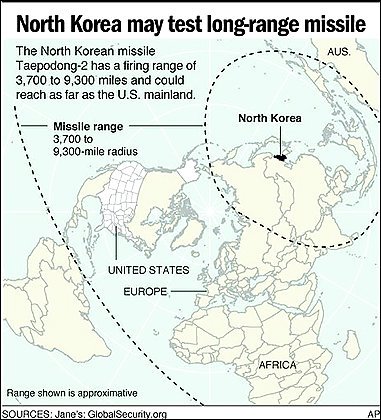
North Korea is suspected to launch Taepodong Ⅱ missile, which poses serious threat to Far Eastern nations. This missile test will undermine the Six-Party peace negotiations, and China and Russia express their concerns. Unlike previous missiles, this brand new arsenal can reach American mainland, as shown in the above map.

Since the Clinton era, Kim Jong Il missile has been using nuclear crises to call an attention from the United States, and have bilateral negotiations. Currently, the economy of North Korea is terrible. Since the collapse of COMECON, North Korea has been isolated from the world economy. In order to sustain the current regime, North Korean leaders badly need economic help from the West. This is one of the reasons why Kim Jong Il hopes to talk with the United States.

According to the Korea Times, North Korea is launching Taepodong Ⅱ because “In an analysis, AFP quoted security experts as saying that the North's preparation may be an attempt to grab the attention of a U.S. government distracted by its nuclear row with Iran.” Furthermore, the writer says “the test-fire of a Taepodong-2 type long-range missile that can allegedly reach as far as Alaska. But its range and accuracy are in doubt” (North Korean Missile Test not Imminent, June 13).

However, Kim Jong Il misjudged the consequence of missile test diplomacy. Things are completely different now. The Bush administration learned lessons from the Clinton administration’s North Korea policy. North Korean is good at cheating and deceiving as witnessed in the last missile test. They acquired nuclear fuel while violating non-proliferation agreement. Current US administration is firmly inclined to the six-party talk, instead of bilateral negotiations with North Korea. In Washington Post, Henry A. Kissinger explains this policy as follows:

What Pyongyang is attempting to achieve -- and what the Bush administration has rightly resisted -- is a separate negotiation with Washington outside the six-party framework, which would prevent other parties in the Beijing process from undertaking joint responsibilities. If bilateral talks replaced the six-party forum, some of America's present partners might choose to place the onus for breaking every deadlock on Washington, in effect isolating the United States. (A Nuclear Test for Diplomacy, May 16)

This missile can reach US mainland, which poses much more serious threat to than previous time. Former Speaker of the House of Representatives Newt Gingrich, currently a Senior Fellow at the American Enterprise Institute, says “America’s actions must be decisive. We are faced with a brutal, totalitarian dictatorship about which we know little. It is acting in defiance of all of its own international commitments. The time for talk is over. Either they dismantle the missile or we the United States should dismantle it.”

Former Secretary of State under the Clinton administration William J. Perry and his Assistant Secretary Ashton B. Carter argue even more hardliner.
But diplomacy has failed, and we cannot sit by and let this deadly threat mature. A successful Taepodong launch, unopposed by the United States, its intended victim, would only embolden North Korea even further. The result would be more nuclear warheads atop more and more missiles. (“If Necessary, Strike and Destroy” Washington Post, June 22).

In order to deal with increasing threat of North Korea, the US-Japanese partnership is getting more and more closer. The missile interceptor test was successful, and the US-Japanese alliance can impose psychological pressure on North Korea. Though former Secretary of Defense William Perry insists on preemptive attack against North Korea, the Bush administration is willing to continue the six-party efforts. The interceptor test will be a great advantage for current diplomatic negotiations.

South Korea’s position is still ambiguous. This country has been pursuing the “Sunshine Policy” to North Korea. However, the public opinion is turning hostile to the North. Even North Korea’s close allies, China and Russia, raise serious concern over this missile test.
(Seoul, Beijing Seek Dissuade NK from Missile Test, The Korea Times, June 27)

The North Korean dictator must understand the risk of missile test diplomacy. This is not as effective as it was in the past. The US-Japanese alliance is more steadfast against a rogue proliferator. South Koreans gradually understand who the real threat is. Pyongyang must act honestly, or defeated in the end.

Friday, June 23, 2006

Democrats Divided on Iraq

In a previous post, “Liberals Rolling Back?: Center for American Progress”, I have evaluated whether Democrats can govern the United States or not. At this stage, liberals have not shown feasible alternatives on Iraq. The media have been critical to the Bush administration’s Iraq policy. However, this is not an advantage for Democrats, because they are divided on troop withdrawal.

Senator John F. Kerry insists that US troop withdraw from Iraq in 12 month. Majority of Democrats are puzzled with his proposal, because they need to strike a delicate policy balance (See “Kerry upsets his party with Iraq pullout plan” and “Kerry's Iraq plan troubles his party” on June 12, New York Times/International Herald Tribune). According to “For Democrats, a Delicate Balance on Iraq” in Washington Post on June 20, Democrats should be “not too hot on withdrawing U.S. troops quickly, but not so cold as to alienate large numbers of Democratic voters furious about the war and eager to bring the Americans home.”

For this purpose, Senator Jack Reed and Senator Carl M. Levin proposed an amendment to support self-sufficiency of the Iraqi government and police. But liberals and antiwar activists support Kerry’s plan. On the other hand, Republicans are unified with Bush.

People tend to speak of the Iraq “quagmire” without careful consideration. However, this is a double-edged sword for Democrats. Unlike widely believed, Democrats are not in a good position when they attack current Iraq policy. In face of intra-party split, Senator Harry M. Reid said, "One thing Democrats agree on is this war has taken too long, it's too expensive and costs too many lives and too many soldiers injured." Also, Senator Joseph Biden insisted that the United States send Baghdad a strong signal to purge sectarian killers from its security forces and bring more Sunnis into the circles of power ("Democrats Divided on Withdrawal Of Troops", June 21, Washington Post).

In any case, the result of the mid-term election is unpredictable. A mere criticism to the Bush administration’s policy does not help Democrats. They must show feasible alternatives, and be firmly unified. Otherwise, they will not be successful in forthcoming mid-term and presidential elections.

Friday, June 16, 2006

Bush Administration Official’s Lecture on US-India Relations

R. Nicholas Burns, Under Secretary of State, gave a lecture on US-India relations at the Carnegie Endowment for International Peace. He was a key negotiator when President Bush and Secretary of State Rice visited India this March. As I mentioned earlier, nuclear issue is the most critical hurdle for new strategic partnership between the United States and India. George Perkovich, Vice President at the Carnegie Endowment, points out policy gaps between non-proliferation specialists and grand strategists. Specialists worry that the US-India nuclear deal would undermine current non-proliferation regime. On the other hand, strategists see this agreement a good opportunity for the United States to have India to contain the Sino-Russian axis.

In the lecture, Nicholas Burns presents clues to these questions. (See the video on Windows Media Player and Real Player.) He mentioned that the strategic partnership has been explored since the Clinton era, because the United States needed realignment for post Cold War threats. Burns argued that policymakers should have a grand strategy view on India, instead of speculating nuclear bargains. He says that the United States and India share common interests in the following areas: security, economy, democracy promotion, and pandemic prevention like AIDS.

In security, Burns argues that America and India need each other. The United States pursues global leadership, and India for regional leadership. India exerted positive influences to bring peace and stability in South Asia. India persuaded the king of Nepal to give up power in order to soothe democracy movements. In Sri Lanka, India sponsored the peace talk between the government and the Tamil Tigers, along with the European Union and Japan.

The economy is no less important than security. As Burns says in the lecture, India is one of the fastest growing markets. According to “India outsmarts China” in Foreign Policy, January/February 2006, Indian economy is more prospective than Chinese economy, because it is more brain-intensive than labor-intensive China. India has become the most attractive market for the United States. US high tech companies invest India. Boeing sells their planes. Bilateral relations expand in every sector, from the government, business, to civil society.

Burns says that the Indo-American nuclear agreement must be understood in this context as well as non-proliferation perspectives. A rapidly growing economy, India needs more electricity, and it must diversify energy supply. This country had been isolated for 30 years from the global economy because it was out of non-proliferation regime. However, he says, India has never proliferated while North Korea and Iran violated non-proliferation rules. Considering this gap in the NRT system, he advocates the United States offer technological assistance to peaceful nuclear use in India. The United States can export nuclear equipments. Also, this is helpful to reduce carbon dioxide emission, he says.

On the other hand, he is so careful that he avoided provocative comments. As Henry Kissinger argues, Burns says it is not American interest to use India a counterbalance to China. His viewpoints are different from those of neocons’ who regard India a trustworthy democracy to contain China. As to Iran, he says India can keep relations with this country, as Europe and Japan do. In addition, he stressed new US-Indian strategic partnership would not undermine US-Pakistani relations.

Mostly, Burns is right. The most critical issue is the nuclear deal. Ashley G. Tellis, Senior Associate at the Carnegie Endowment, testifies that this agreement should not be changed through congressional debates, because it is practical. India does not trust NPT, but it is necessary to impose non-proliferation duties on this country. To make it successful, the United States must offer something in return. Also, he insists that the congress not require burdens for the US and Indian governments to change this agreement.

The negotiation is still in progress, as the Times of India reports. The key to pass the debate at the Hill is how far the verification will be carried out under the agreement. For the United States, India has much potential as a market and a strategic partner. However, the bilateral deal must not damage current non-proliferation regime.

See also the Real Truth.

Tuesday, June 13, 2006

More Input, Please Wait

I have not posted articles these days, because I have lots of unread e-mail alerts. I need more information input.

I will write new posts soon. Please wait. Thank you.


Shah Alex

PS: Albion, the co-writer of this blog, has come back to the US now. He will be writing interesting posts.

Saturday, June 03, 2006

NATO Defense Ministers Meeting and Agendas for the Future

NATO defense ministers meeting will be held on June 8 in Brussels. In the post-Cold War era, NATO forces act outside Europe. The agenda in this meeting will be the key to US strategy and its relations with allies.

Julian Lindley-French, Senior Scholar at the Center for Applied Policy, University of Munich, has contributed an article “For the Crucial Alliance, a Day of Decision” to the International Herald Tribune on May 30.

He says this meeting is important to set the agenda for the summit meeting in Riga this November. In face of increasingly authoritarian and assertive China, and erratic and untrustworthy Russia, NATO must transform itself into a global security alliance. For this objective, he suggests four points to be discussed.

1. Structural interventions:
Be clear about the reason for intervention. The alliance intervenes when democratic security is threatened. A new concept of structural intervention is required to re-energize NATO objectives.

2. Smart organization:
If NATO were to act globally, its forces must be more professional and smaller. It is necessary to strike a balance between rapid reaction and enduring operation to accomplish the mission for stability and reconstruction.

3. Smart transformation:
In face of new threats, like Russia, China, and other smaller autocratic states, NATO must develop a collective military capability. Also, NATO forces must be agile and multinational to adjust themselves to diversified missions.

4. Smart partnerships:
NATO can work with democracies in the Asia Pacific, the Greater Middle East, and Latin America. The June 8 meeting should be the first step toward a big NATO.


The above four points are crucial for American allies outside NATO as well. Japan, Australia, and New Zealand will act with NATO from Suez to the Pearl Harbor. Currently, US forces in Japan are under transformation, and this is a vital issue in Japanese national security. What happens in the Atlantic and the Pacific is strongly interrelated. Also, some like India, aspiring for a strategic partnership with the United States, needs to pay attention to issues discussed at the ministers meeting.

They are agendas for American global strategy, not only for the transatlantic alliance.

Saturday, May 27, 2006

Book Review: Eternal Japan-US Alliance

I would like to write a post based on a Japanese opinion leader’s viewpoint this time. The book is entitled “Eternal Japan-US Alliance: Nothing Wrong with Being America’s Tributary State!” or "日米永久同盟:アメリカの「属国」でなにが悪い!" (Kobunsha Press 光文社, by Hidemi Nagao 長尾秀美, Public Relations Officer of US Navy in Japan). This Japanese book is recommendable to understand the US-Japanese alliance , because it is lucid.

Nagao questions the vital point on the US-Japanese alliance in the future.

Is Japan willing to continue alliance with the United States?

Should the United States declare abrogation of the US-Japanese alliance, what would Japan do? Why doesn’t Prime Minister Koizumi face this vital agenda without considering any countermeasures? While People call the Prime Minister “Bush’s lapdog”, he is not interested in strengthening the US-Japanese alliance at all. I wonder why he does not care about it.

Some Japanese opinion leaders criticize that Japan is becoming a “tributary state of the United States” under current transformation of US military organizations. However, Hidemi Nagao refutes their ideas flatly, and insists that the Japan can never win trust from the global community without staunch alliance with the United States. Therefore, he says that Japan must be “a trustworthy tributary state” to the United States. He rejects any kind of alternatives other than closer US-Japan partnership. His arguments are clear and insightful.

In the Introduction, Nagao refutes a commonly believed fiction among Japanese people, “Unprecedented US-Japanese Friendship between Bush and Koizumi.” Under the transformation of US forces, transfer of Okinawa troops has emerged a crucial agenda between Japan and the United States. However, he criticizes that Prime Minister Junichiro Koizumi cares nothing but pleasing Okinawa citizens to get Futenma airbase returned to Japan. While American side talks about basic concepts of military transformation, Japanese side is not interested in it, according to Nagao.

Surprisingly enough, Prime Minister Koizumi canceled the US-Japanese summit last September, because he was reluctant to talk on critical issues like military transformation and BSE beef problem. His attitude is questionable, because the United States was prepared for this state visit. Only “Shukan Bunshun 週刊文春” (one of weekly journals, widely circulated in Japan) took up this news among Japanese media. Also, Koizumi refused to attend the 60th memorial ceremony of VE Day in the World War Ⅱ, because Japan was a loser in this war. I feel resented to hear this. Japan would have been able to demonstrate that it shared common historical perception with the United States, and liberate itself from the postwar framework.

In Chapter 1, the author blames the media tend to exaggerate misbehavior by US soldiers. Also, he mentions widespread misunderstandings among Japanese people on the US-Japan Status of Forces Agreement. In this chapter, he emphasizes that the US Forces in Japan play the key role to maintain peace and stability from East Asia to the Indian Ocean. Most importantly, he insists that Japan establish real trustworthy relations with the United States as the “most reliable tributary state.” That is, people need to be realist to admit that Japan cannot act on its own, and it is vital for Japan to keep the US-Japanese alliance as the crown jewelry in foreign policy. Of course, he does not advocate blind follwership to US policy. Japan must establish a mutual trust between the United States, based on common universal values of freedom and democracy.

From Chapter 2 to Chapter 5, the author comments on history of Japanese diplomacy, particularly US-Japanese relations and the Anglo-Japanese alliance. We can learn a lot from history, particularly how to make the alliance effective. The author says the alliance must be bilateral, not unilateral. This is why the Anglo-Japanese alliance was abolished. Since then, Japan had no defenders, and ran into a fanatic policy of building up the Greater East Asia Co-prosperity Zone. I am concerned that Japanese politicians say that the alliance is necessary because Japan must be “protected by the United States.” British leaders advocate more bilateral alliance.

In Chapter 6, Nagao argues that the United Nations not a reliable peacemaker. As he comments, the United Nations does not have peacemaking capability at all. He analyses the reason for this, and suggests that Japan withdraw from the UN. He says that UN membership does not pay off for Japan, considering its budget contribution to the United Nations and its position in this organization. Rather, he says, Japan should use this money for bilateral aid or small business assistance. Furthermore, Nagao condemns China’s high-handed diplomacy in the United Nations: less budget contribution to the UN than Japan, receiving ODA from Japan, but using veto to impose its national interest through the United Nations.

What should Japan do after withdrawal from the UN? In Chapter 7, Nagao proposes to extend the US-Japanese alliance for 100 years in order to manage threats from the Chinese Empire and Russia. Britain and Australia can join this alliance to make the Far East Democracy Peacemaking Coalitions, he says.

His idea in the final chapter is controversial, but the author is consistent in his thorough realism to admit that Japan cannot enjoy peace and prosperity without the umbrella of American hegemony. I agree with him in his contempt to the United Nations and blind pacifism. Finally, it is noteworthy that the author emphasizes the importance of common universal values as the foundation of the Trans-pacific alliance. Otherwise, he says, Japanese people will live in peace and stability under the Chinese Empire. While Japanese rightists get nervous to Chinese threat, they do not care enough about common universal values between the two biggest democracies in the Asia Pacific region.

Thursday, May 18, 2006

America's Three Musketeers?: Britain, Japan, and India

I found an interesting article in “National Security Outlook December 2005”, published by the American Enterprise Institute. In the article, entitled “The Big Four Alliance: The New Bush Strategy”, Thomas Donnelly, Resident Fellow at the AEI, argues the following.

Over the past six months, the Bush administration has upgraded its budding “strategic partnerships” with Japan and India. Along with the steady “special relationship” with Great Britain, what is beginning to emerge is a global coalition system—it is too soon to call it a true alliance—for the post–Cold War world. Much work remains to be done to translate the expressions of similar political interests and values into usable military strength. Still, the prospects for expanding the number of genuine “stakeholders” in the Pax Americana are quite bright.

Certainly, the United States needs to restructure new strategic partnerships with key allies, in order to manage the post-Cold War dangers. Basically, I agree to his viewpoints, but it is necessary to examine how things are developing since then. The special relationship with Britain is likely to remain solid, but some problematic aspects must be considered when it comes to alliance with Japan and India.

First, let me review the article by Donnelly. He points out that it was not the war against Iraq but unilateralism provoked criticism to the Bush administration. In order to enhance the liberal world order in the post-Cold War era, the United States has to build new alliances of the Big 4, including the United States, Britain, Japan, and India, he says. According to Donnelly, the Big 4 share four strategic principles:

(1) Managing the dangers in the Greater Middle East, like radicalism, autocrats, and nuclear proliferation
(2) Curbing Chinese threat
(3) Promoting democracy for durable peace
(4) Recognizing the necessity of using military force (Doubtful for Japan, I think.)

In addition to common strategic objectives, three countries share geopolitical similarities as Eurasian offshore balancers: Britain to Europe, Japan to Asia, and India to the Middle East and China. Donnelly insists that the central pillar of the Big 4 be the United States. Freed from the Cold War constraints, the United States can pursue the mission to advance freedom and democracy throughout the world as stated in the Bush Doctrine. To achieve this goal, Donnelly argues that Secretary of Defense Donald Rumsfeld’s temporary "coalition of the willing" must be supplanted to more permanent arrangements. I agree to this policy blue print, and let me see his arguments on new strategic partnership one by one.

The most stable and reliable partner is Britain. The Anglo-American special relationship has been revitalized by the Blair administration. Prime Minister Tony Blair pressed President Bill Clinton to get involved in Balkan without UN mandate, and supports President George W. Bush in Iraq and Afghanistan.

While the special relationship is likely to remain strong after Blair, British armed forces are small albeit competent. This is the problem to sustain extensive overseas commitment. Nevertheless, Donnelly calls the Anglo-American alliance the gold standard for some countries aspiring staunch partnership with the United States, particularly Japan.

Since the “Armitage Report” was published, Japan is remodeling its alliance with the United States after the Anglo-American special relationship. The report advises that Japan reconsider its pacifist constitution. Currently, Japan faces serious threats from China and North Korea. Therefore, Japan deadly needs US presence, and develops further cooperation like the missile defense program. In addition, Japan sent troops to support US operations in Iraq and Afghanistan.

However, Japan’s Self Defense Force lacks operational experiences. Moreover, Japan’s defense spending is still within 1 % of its GDP, due to constitutional and political constraints. Therefore, Donnelly comments that Japan’s current capability is far below its potential.

India has emerged as a new strategic partner to the United States since 9-11. Indian forces are well experienced to fight against Islamic terrorists in Kashmir. Also, some American policymakers expect India to counterbalance against China. However, Donnelly points out that Indian weaponry systems are still predominantly Cold War Soviet made. This is a handicap to work closely with the United States.

Donnelly regards the Big 4 alliance more potential than real. Some strategic cooperation was initiated by the Bush administration, but it remains to be seen whether their common interests and values can make this coalition more permanent basis of the Pax Americana.

Basically, I agree with Donnelly, but he does not mention some hurdles in each country in this article. Time has passed since then, and I feel it necessary to examine the Three Musketeers one by one.

First, I comment on Britain. Tony Blair’s likely successor Gordon Brown, Chancellor of the Exchequer, will continue New Labour policies. However, Labour leftists may backlash, because they feel current policies deviate from Fabianism, the ideological foundation of the Labour Party. Careful observation of political process after the loss of Labour defeat in the last election is necessary.

As to Japan, there are some worrisome trends. A few years ago, a US soldier in Okinawa raped a Japanese elementary school girl. This infuriated people in Okinawa, saying that US bases are excessively concentrated there, and they have been bearing this burden for decades. Since then, some Japanese media report US bases as if they were troublemakers. Also, under the recent US-Japanese arrangement, Japan should pay for moving some Okinawa bases to Guam, US territory. These incidents provoke anti-American sentiments.

Moreover, tensions with China and Korea stimulate nationalist emotions to legitimize Japan’s wartime behavior. Apparently, this is incompatible with common values of freedom and democracy.

Regarding India, the most critical issue is the Indo-US nuclear deal. Quite a few opinion leaders warn that this arrangement will destroy current nonproliferation regime. Henry Kissinger is positive to bolster US-India strategic partnership, but he does not agree to use India a counterbalance against China, because India acts its own. Also, America must strike a balance between India and Pakistan.

Does India share common values with America? According to Freedom House index, India belongs to “free country” category, but not the top level. While the Bush administration regard India a trustworthy democracy, careful approaches to this country is necessary.

British historian Niall Ferguson, Professor at Harvard University, raised a question whether the United States has stamina for further involvement beyond regime change. I believe successful partnership with Eurasian offshore balancers is vital for this question. I would like to review these strategic partnerships individually in the forthcoming posts.