The Sochi Olympics and Paralympics are politically questionable events. This is the Olympic of Putin, by Putin, and for Putin. It is not just a matter of gay rights. Kremlin’s priority in national pride and dignity sacrifices the well being of citizens living around the venue. While major Western leaders abstained from attending the opening ceremony to express their concerns with human rights oppression in Russia, Japanese Prime Minister Shinzo Abe stood out in the Western alliance to have a bilateral talk with Russian President Vladimir Putin, in view of geopolitical rivalries with China, the conclusion of the peace treaty, and natural resource development in East Siberia. I would like to explore political implications of this Olympics and Paralympics, in consideration of G8 this June and the unrest in Ukraine since November last year. And then, I would discuss whether Japan will fall into another Hatoyama error by its independent action to Russia in the alliance of Western democracies. Whatever the reason is, this is contrary to Abe’s new National Security Strategy that stresses the alliance of common democratic values.
The Sochi Olympics had two objectives. First, it was intended to demonstrate Russian power on the global stage, and second, to impose political and military pressure on neighboring areas Caucasus and Ukraine by concentrating security forces in the Black Sea area. This Olympics is far from Baron Coubertin’s ideal to enhance friendship through sports. Let me tell stark between the Olympics of freedom in London 2012 and those of state-led authoritarianism in Beijing and Sochi. Like Beijing 2008, Sochi 2014 is an event to demonstrate the power of autocracy, hardly giving consideration to the well being of domestic citizens. For the sake of Olympic site construction, it is well known that numerous people living there were displaced in both games. Here I would like to show an by Human Rights Watch below.
According to the video reported from a mountain village Akhshtyr between skating sites in Sochi and skiing sites in Krasnaya Polyana, the highway and the railroad to connect both venues have divided the life sphere of the villagers along the road. They are forced to go long ways around to the opposite side of the highway. Road construction has dried up wells for their daily life and caused a few kinds of environmental degradation there. Jane Buchanan, Associate Director of Europe and Central Asia at Human Rights Watch, comments that villagers are poorly compensated for such losses. Apparently, the well being of the narod is none of Putin’s interest, who is preoccupied with Russian power in the world.
Unlike Sochi and Beijing, London had hardly any problems with such displacement and marginalization of inhabitants. Most notably, state authority was out in front both in Sochi and Beijing, while not in London. This is typically illustrated in the fact that it was Mayor Boris Johnson who vehemently refuted Republican Presidential Candidate Mitt Romney’s inappropriate comment about the London Games, neither Queen Elizabeth nor Prime Minister David Cameron. Unlike citizen-led Olympics in London, Sochi and Beijing were ridiculously obsessed with the great power syndrome. Comparing national power of these three counties from various aspects of hard power and soft power, assertive Russia and China are not necessarily advantageous over modest Britain. Both are far greater than Britain in the area and population. Also, Russia is the only nuclear archrival to the United States. However, neither Russia nor China has global power projection capability that Britain has, despite their rapid military build up these days. The gross economy of China may be so gigantic as to rival the United States, but its per capita income is far lower than those of G8 nations. Moreover, who buys Chinese and Russian brands over British and American? In soft power, Britain overwhelms both Russia and China. The Global Times, an English language newspaper run by the Chinese government, belittled Britain when Cameron visited China (“‘Britain is merely a country of old Europe with a few decent football teams': Chinese newspaper criticises UK during David Cameron visit” Independent; 3 December, 2013), but it is China that depend on British and American media fr their anti-Japanese campaign on wartime history and the Senkaku territorial clash. Therefore, great power obsessions of both autocracies
associated with the Olympics and Paralympics is quite absurd.
I would like to argue that the problem of big spending Sochi Olympics is much deeper than gay and lesbian rights. Abe’s step out from the Western alliance protest to Russia was already problematic even before the Ukrainian crisis developed so critical as it is today. Regarding oddness of Sochi, I would like to mention hospitality to visitors. Tourists from overseas complain poorly furnished running water and toilets at their accommodations in Sochi on Twitter (“#BBCtrending: Does Russia think it has #SochiProblems?”; BBC News; 8 February, 2014). There is no doubt that construction workers at Sochi facilities hardly gave consideration to customers who use them, but merely thought of satisfying Putin who craved for building them so hastily. This is typical, command and control mindsets of the old Soviet Union, hardly any consideration to omotenashi or generosity to visitors. This was not the case with London. Seen from every respect, Sochi is too repressive to host the Olympic s and Paralympics.
The Ukraine crisis closely related to such a power oriented nature of Putin’s Olympics. It is Russia’s vital interest to keep its influence in former Soviet republics in view of geopolitical rivalries against the West. Meanwhile, Japan's outreach to Russia is quite noticeable. The unrest in Ukraine began in November, and Putin’s aggression was somewhat predictable. Apparently, Sochi is associated with so many political problems. It is regretful that Abe attended the opening ceremony to cheerlead Putin, while none of American and European leaders did. Of course, it is somewhat understandable that Japan finds some necessity to move closer to Russia. Since the Fukushima accident, Japan is in need of diversifying energy supply source, and exploring partnership with Russia for oil and gas in Eastern Siberia and the Arctic area (“Japan and Russia: Arctic Friends”; Diplomat; February 1, 2014). In terms of geo-strategy, Japan eyes on Russia to offset growing expansionism of China. Also, Abe thinks it necessary to placate Russia, in order to settle long disputed South Kuril territory issue since the end of World War II. Foreign Minister Fumio Kishida barely urged self restraint of stakeholders on Ukraine, so as not to provoke Russia at the press conference on March 4 (“Between a Rock and a Hard Place: Japan's Ukraine Dilemma”: Diplomat; March 8, 2014). Even anti-Abe Asahi Shimbun agrees to Abe’s stance of balancing Russia and the West (“Editorial: Regional Stability before the Russo-JapaneseTerritorial Talk:”; Asahi Shimbun; February 10, 2014).
However, is Putin so generous as to meet Japan’s security requirements, in return for Abe's cheerleading in Sochi? Certainly, Russia needs Japanese money and export market for oil and gas, in order to boost the economy of underdeveloped Far East. But Putin’s primary strategic goal is defying Pax Americana, in order to claim Russia as a nuclear archrival to the United States and geopolitical great power in the world. Rather than a counterbalance, Russia founded the Shanghai Cooperation Organization with China to challenge the Western alliance. Actually, China implicitly says that the West is responsible for the turmoil as well as Russia, at the press conference by Foreign Ministry spokesman Qin Gang on March 2 (“China Backs Russia on Ukraine”; Diplomat; March 4, 2013). Remember that Russia had been the most frequent intruder to the Japanese airspace until surpassed until China in 2012 (“Japan’s Air Defense Scramble Doubled Last Year”; J-Cast News; April 18, 2013). In addition, I can hardly expect Putin is more bountiful than Dmitry Medvedev who visited Kunashiri as a president in 2010. Russia has invested to lifeline facilities in South Kuril, which implies Kremlin’s long term adherence to the disputed islands.
Rather than cheerleading a dictator, Abe should abide by his own principle stated in the NSS (National Security Strategy) that Japan defend liberal international order, its values, and the alliance of democracies. From this point, it is utterly ridiculous that Japan balance Russia and the West. Such policies failed in Iran to maintain Japanese business interests in the Iran-Japan Petrochemical Project and Azadegan oil field. Also, Former Prime Minister Yukio Hatoyama’s dream of the East Asian Community to balance the United States and China was shattered miserably. It appears to me that Abe’s cheerleading to Putin is a kind of Hatoyamanization even before the Ukrainian crisis. Abe may have reached some agreements with Putin in Sochi (“Japan Russia Summit: Further Talk on Putin’s Visit to Japan”; Sankei Shimbun; February 8, 2014), but they were made in a festive mood. Considering autocratic and power-oriented nature of the Putin regime as revealed in the Ukrainian crisis, his possible visit to Japan will simply cool down the US-Japanese alliance without improving the territorial issue and Far Eastern security environment (Abe’s dilemma between the United States and Russia”; 47 News; March 7, 2014).
Based on NSS principle, Japan is in a position to save Crimean Tatars from humanitarian points as they face threats of pro-Russian militias. Putin’s aggression reminds them of tragic history of imposed deportation by Joseph Stalin (“Russian occupation opens old wounds for Ukraine's Crimean Tatars”; Sydney Morning Herald; March 11, 2014). Abe’s visit to Yasukuni caused unnecessary tension with the United States, and further tension must be avoided. Finally, international sports organizations like the IOC must give more consideration to political aspects to select the host city. Sochi and Beijing have so many problems to hold Olympics and Paralympics. In the real world, sports and politics cannot be separated. Never cheerlead dictatorship. The problems of Sochi and Ukraine are deeply interconnected.
Thursday, March 13, 2014


Friday, February 28, 2014
An Online Shop to Promote Awareness on Wildlife Conservation and Global Security

I am pleased to tell you that my onlineshop has opened recently. Actually, this shop shares common ideals with my policy advocacy. The shop deals with two areas, which are animal osteological specimens and history/military items. Those items are related to rulers of natural and human world. Therefore, they are masculine and fashionable.
As to osteological specimens, primary items
are skulls of lions and tigers, the kings of wildlife. In history/military
items, my shop imports American and British armed forces apparels and gears.
Customers can enjoy the feel of the World Policeman. Also, history items
related to great empires will be added to the goods line.
Merchandise sold at this shop is not just
for hobby, but for education and public interest. It will promote awareness on
wildlife conservation and global security, by feeling and touching items of the
kings of the nature and the world policeman.
Sunday, January 19, 2014
Abe’s Tribute and Similarities between Yasukuni and Al Qaeda
Prime Minister Shinzo Abe’s surprise visit
to the Yasukuni shrine spurred controversy on the resurgence of Japanese nationalism.
On behalf of the US government, Ambassador Caroline Kennedy released a
restrained message of “disappointment” shortly after his visit (“Japan leader’s shrinevisit draws criticism from U.S., Asian neighbors”; Stars and Stripes; December25, 2013). There is no doubt that Abe’s behavior intensified tensions with
China and South Korea, and ruined improved US-Japanese relations through
settling the Futenma US base problem in Okinawa.
It is not Japan’s disagreements on wartime history with China and South Korea, but supposed defiance to liberal world order based on the Atlantic Charter that really matters. The Yasukuni Shrine is called the War Shrine in the West as it honors war criminals in the Pacific War along with numerous unknown soldiers. The vital problem is the ideology of this shrine. I went tothe shrine on December 22, 2005 to see what it is, without paying tribute towar criminals. What struck me was not just Yasukuni made the case against the Tokyo Tribunal for war crimes, but praised the brainwash to innocent youngsters for suicide bombing under the name of divine emperor. This is exactly what Al Qaeda does today under the name of Allah.
The ideology of suicide bombing is a Dark Age creed, which is utterly unacceptable to any civilization of rationality and humanity since the Renaissance. Therefore, the problem is not whether winner or loser in World War II, nor do I endorse that Japan appease China and Korea. The focal point is simple. The Yasukuni ideology is completely incompatible with the universal value of human being. Remember, even Adolph Hitler did not adopt such barbaric and inhumane tactics. Only wartime Japan and Al Qaeda conducted organized and large scale suicide attacks under the name of the God. Japanese right wingers must bear it in mind. It is not foreign pressure and criticism that really matters, but in which position do the Japanese stand. Current Japan is at the heart of Western democracies fighting against the ideology of lunacy and hatred upheld by terrorists.
Like it or not, Japanese policymakers need to analyze the impact of Abe’s visit to Yasukuni on Asia-Pacific diplomacy. As widely known, Abe wants to “disentangle” Japan from the postwar world order to restore national pride. But his attendance to the ritual at the shrine is regarded as an act of legitimizing wartime militarism among Asian nations, particularly China and South Korea. Also, sore relationship with the United States is critical. The Bush administration tolerated Prime Minister-then Junichiro Koizumi’s visit to Yasukuni, because they needed the coalition of the willing to topple Saddam Hussein. Under the Obama administration, America adopts strategic rebalance to Asia, and they are reluctant to accomodate Japan’s “unnecessary” clash with China and South Korea. From these points of view, Professor Aurelia Mulgan at the University of New South Wales, comments critically to Abe’s “self-satisfactory” visit to Yasukuni simply ruined security in East Asia (“Abe puts personal interests ahead of Japan’s at Yasukuni”; East Asia Forum,1 January 2014).
We should note that the Obama administration worked very hard to soothe vehement anti-Japanese postures by the Park administration of South Korea regarding the wartime comfort women issue. When Vice President Joseph Biden visited South Korea early December, he urged President Park Guenhye to improve relations with Japan. Abe’s conduct ruined such efforts (“Abe’s Yaskuni Visit Did not just Dissapoint, but Resented the US”;47 News; December 29, 2013). On the other hand, it is necessary to understand the background Abe’s visit to Yasukuni. Whether the Japanese prime minister attends a ritual at the War Shrine or not, tensions in North East Asia are growing worse. South Korea’s Park administration was moving toward increasingly pro-Chinese since the inauguration. China self-claims the ADIZ (Air Defense Identification Zone) around the Senkaku Islands to challenge US-Japanese maritime supremacy. Furthermore, Michael Auslin, Resident Scholar at the American Enterprise Institute, points out that Vice President Joseph Biden’s talk with Chinese President Xi Jinping early December appeared appeasing for Abe. Therefore, he argues that Abe resorted to preemptive action to demonstrate that Japan shall stand unapologetic to China and South Korea on history (“Japan OfficiallyEnters Cold War with China and Korea”; National Review Online; December 26,2013).
I shall not agree to Abe’s view on Yasukuni, but if his premise is right, the timing of the visit was very consummate. Abe paid tribute to war victims at Yasukuni including criminals on December 26, which exactly coincides with Mao Zedong’s birthday (“China to celebrate Mao'sbirthday, but events scaled back”; Reuters; December 25, 2013). As the Xi administration upholds Maoist resurgence in order to rectify growing social inequality and corruption, Abe’s Yasukuni ritual was extremely well planned to crack own inflammation of patriotic passion in China. I wonder why didn’t the media refer to this. Also, Japan took psychological advantage of helping South Korean army in South Sudan through offering bullets (“Japan supplies ammo to S. Korean military units in South Sudan”; AsahiShimbun; December 24, 2013). Furthermore, South Korea rejected to act with China to protest Abe’s tribute to war criminals. South Korean Foreign Minister Yun Byungse said that Seoul must deepen strategic partnership with Japan and the United States to manage East Asian security, despite disagreements on wartime history (“South Korea Cautious of Allying with China over Yasukuni”; JijiPress; January 1, 2013).
Regarding Japan’s foremost diplomatic priority, which is the alliance with the United States, Abe settled long disputed Futenma Marine Base issue in Okinawa that was terribly mismanaged under the Hatoyama administration. From this point, Abe may have been confident of American tolerance to Yasukuni. Even if the White House and the Department of State were displeased with such nationalist posture, Abe could count on understanding demeanor from the military industrial complex. In view of defense cuts in the United States and Europe, Japan is a prospective market for the defense industry as it increases the defense budget to face off against growing threats of maritime ambition of China (“Boeing Gets $661M Defense Orders”;Zacks Equity Research; December 27, 2013). The focal export item to Japan is P8A anti-submarine patrol aircraft manufactured by Boeing, whose parts and equipment also come from other major defense contractors such as Northrop Grumman, Raytheon, and General Electric. So many defense firms are involved in this (“Chinavs. Japan: Will Boeing's New Submarine-Destroying Jet Get Battle Tested?”; MysteryFool; December 21, 2013).
Considering the above mentioned points, I would argue that Abe’s visit to the War Shrine was not necessarily reckless though opinion leaders both in Japan and abroad criticize it. As long as the military industrial complex is on his side, there is nothing strange if he thought the Obama administration’s aversion to nationalist posture was trivial. Rather, Abe’s conduct looks quite canny like Cardinal Richelieu. However, it seems that a crafty man has fallen oft into the snares of craft. The Yasukuni Shrine has an inherent problem with its fundamental values, and this is beyond Pacific War winner-loser standpoints.
Strangely enough, hardly any pro-Yasukuni politicians in Nagatacho try to explain why Yasukuni values are acceptable to the world today. Nor do Shinto priests at the War Shrine do so to improve accountability. Most symbolically, it is necessary to tell the difference between “Long live the Emperor!” and “Allah akbar!”. An ideology of suicide bombing under the name of the god shall not be accommodated, regardless of ethnic, cultural, and religious backgrounds. I do not have any objection to honor people who dedicated their lives to the nation. But the nature of current Yasukuni Shrine needs to be considered, before attending a ritual there. It is not the protest of China and South Korea, nor disappointment of the United States. What really matters is the implication of this shrine to a democratized Japan.
Thursday, January 09, 2014
Launching a New Facebook Group
I have launched a new group on Facebook, named the Advocacy for the World Policeman. This group endorses America’s special role as the world policeman, and makes cases against free riding by US allies. The group opposes any kind of super power suicide in order to advocate our liberal world order.
If you are on Facebook, come and join us!
If you are on Facebook, come and join us!
Wednesday, January 01, 2014
New Year Greeting
Happy New Year!
This is a year of super horse. You see, Alice stands between the Lion and the Unicorn.
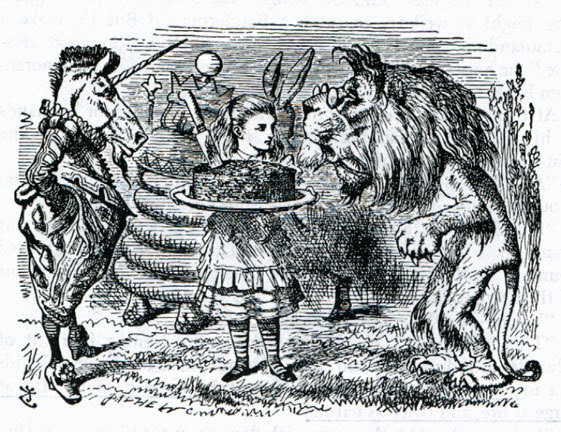
Very British? Certainly.
This is a year of super horse. You see, Alice stands between the Lion and the Unicorn.

Very British? Certainly.
Monday, December 30, 2013
Has Iran Turned Dove Enough for Nuclear Talk?
The inauguration of moderate Rouhani administration is taken so favorably among the media and experts, and some of them even expect détente with Iran. The appointment of Mohammad Zarif to the foreign minister, who has close personal ties with American political corridors, intensifies such a welcome trend furthermore. It is understood that Iran’s sanction hit economy is leading towards a possible diplomatic thaw with the West. But it is premature to assume that Iran is turning into a peace-oriented state. Ever since taking office, President Hassan Rouhani has not denied his predecessor Mahmoud Ahmadenejad’s notorious remark of “wiping out Israel”. In addition, Iran is taking some actions to challenge the West, while nuclear talks are ongoing. Also, the Geneva process is not necessarily technically complete to stop Iran’s nuclear ambition, which raises critical concerns among France, Israel, and Gulf Arabs.
First, let me mention Iran’s geopolitical power game against the West, in parallel with nuclear negotiations. Prior to the Vienna talk from December 9 to 12 to proceed the Geneva process, Rouhani agreed the cooperation pact with Afghan President Hamid Karzai. At the bilateral talk, Rouhani demanded Karzai that all foreign troops in Afghanistan pullout completely (“Afghanistan agrees to pact with Iran, while resisting US accord”; FOX News; December 8, 2013). Currently, Afghanistan’s BSA negotiation with the United Sates is deadlocked, because Karzai overturned the approval by Loya Jirga, and demanded that the American side reconsider legal jurisdiction to US soldiers in case of misconduct, supply better weapons to the Afghan forces, and specify the duration of military presence in Afghanistan (“Afghan President Hamid Karzai says he’ll delay signing of U.S. accord on troops”; Washington Post; November 21, 2013).
Jarad Morzai, Spokesman at the Afghan Ministry of Foreign Affairs said that Afghanistan would pursue good relations with both Iran and the United States (“Afghanistan rejects reports on Iran’s support to Afghan militants”; Khaama Press; December 15, 2013). Meanwhile, Iran denounces the US-Afghan BSA because it extends foreign troop presence beyond 2014 when the NATO mission in Afghanistan ends (‘US-Afghan security pact detrimental for region’; Press TV; December 3, 2013).
Iran makes another move to irk America. While the talk between Secretary of Defense Chuck Hagel and Pakistani Prime Minister Nawaz Sharif in Islamabad ended chilly over drone attacks, Iranian Petroleum Minister Bijan Zangeneh and Pakistani Petroleum Minister Petroleum and Natural Resource Minister Shahid Abbasi announced that both countries would resume the pipeline project in Tehran. The United States objects to the deal for fear of hollowing current sanctions against Iran. To satisfy appetite for gas from Iran, Pakistan ignores infrastructure aid by the United States in return for continuing the sanction (“Pakistan Wants to Accelerate Iran Natural Gas Pipeline”; Diplomat Magazine; December 11, 2013). Iran’s thrust into Pakistan and Afghanistan suggests that the détente with the United States has yet to come.
Syria is another geopolitical issue interconnected with nuclear talks. Iran is at odds with the West as it sponsors the Assad regime, recruits militia to fight in Iraq, and allies with Hezbolloah to expand influence in Lebanon and deter Israel. This is defiance to UN-backed Syria conference to be held at Montreux in Switzerland on January 22. While Rouhani is exploring nuclear deals to ease sanctions, the Revolutionary Guards harness his efforts to aid terrorists. Andrew J. Tabler, Senior Fellow at the Washington Institute for Near East Policy, comments “A deal on the Iranian nuclear program isn’t going to work if you cede the hard-liners the Levant”. On the other hand, “Iran’s position on Syria is that the alternative to Assad is more dangerous to both U.S. and Iranian interests than the status quo”, according to Karim Sadjapour, Senior Associate at the Carnegie Endowment for International Peace (“On Iran and Syria, Tests of Diplomacy Intertwine”; New York Times; December 19, 2013). The problem is, whether it is possible to consider nuclear negotiations and Iran’s geopolitical defiance separately.
In addition, Iran’s Defense Minister Hossein Dehghan announced that the Iranian forces improved accuracy of longer range ballistic missiles with laser technology, when the Vienna process started. The US Department of Defense is critically concerned with rapid technological progress in Iran’s missile accuracy (“Iran Asserts Dramatic Gain in Ballistic-Missile Precision”; Global Security News; December 9, 2013). Those missiles are formidable enough to pose threats to Gulf emirates and Israel. Why does Iran have to improve their missiles, if they are seriously committed to stop the nuclear project?
Current Iranian economy is bitterly hit by sanctions. Oil export dropped 60% in the past two years. GDP shrank 5 to 6%, and inflation and unemployment rose 45% and 35% respectively. Vasil Nasr, Dean of the School of Advanced International Studies at Johns Hopkins University, argues that world powers seize this opportunity to advance nuclear negotiations with Iran rather than imposing pressure on them (“Iran’s Economic Crossroads”; New York Times; December 4, 2013). Iran has every reason to ask world powers to lift sanctions in return for accepting UN inspection. However, it is dangerous to assume that Iran will abide by global nonproliferation norms simply for the sake of the economy. Technically speaking, Iran can cheat the deal. In addition, the nature of the Iranian regime must be questioned.
Under the Geneva agreement, Iran must stop uranium enrichment beyond 5%, accept UN inspections, and stop operation at the Arak plutonium plant. In return, P5+1 will ease sanctions on Iran’s oil and petrochemical export, and establish financial channels to facilitate humanitarian economic transaction. Also, no further nuclear related sanctions will be imposed by the United States, the EU, and the UN Security Council (“Full Text of Iran-5+1 agreement in Geneva”; Global Security News; 24 November 2013). The problem is, Iran can continue to enrich uranium, and there are gaps in understanding the agreement between Iran and the West. Israeli Prime Minister Benjamin Netanyahu said that the deal was a historic mistake to make Iran another North Korea as it admits Iran to enrich uranium (“Iran agrees to curb nuclear activity at Geneva talks”; BBC News; 24 November 2013). In view of common threats, Israel turns to Saudi Arabia for possible strategic partnership. Iran sponsors Hamas in Palestine and Lebanon, Assad in Syria, and Shiite dissidents in Gulf emirates. In addition to this, both Israel and Gulf Arabs worry that the United States is proceeding cooperation with Iran at the expense of them (“Iran nuclear deal triggers anxiety for Israel and Gulf”; BBC News; 25 November 2013).
Geopolitics is not the only reason for such distrust to the Obama administration among America’s Middle East allies. Prior to the Geneva negotiation, secret talks between the United States and Iran were held in Oman. Despite concerns raised by Israel and Gulf Arabs, British Prime Minister David Cameron said the deal "demonstrates how persistent diplomacy and tough sanctions can together help us to advance our national interest" (“Secret talks helped forge Iran nuclear deal”; Guardian; 25 November 2013). Are the things so optimistic? As a stakeholder of the Geneva process, French Foreign Minister Laurent Fabius raises concerns with the second phase of the agreement “to curb global financial penalties against Iran if the Middle Eastern power restricts certain elements of its nuclear program”, because "It is unclear if the Iranians will accept to definitively abandon any capacity of getting a weapon, or only agree to interrupt the nuclear program" (“French Foreign Minister: Iran Might Not Give Up Nuclear-Arms Potential”; Global Security Newswire; December 19, 2013).
Actually, a similar deal was proposed in 2005, which allows Iran to enrich uranium while restricting the number of centrifuges. But the Bush administration and the European Union rejected it (“An enriching dialogue with Iran — with limits”; Washington Post; October 18, 2013). Is the Geneva deal a retreat from 2005? The Senate Foreign Relations Committee led by Democrat Senator Robert Menendez introduced the bipartisan Nuclear Weapon Free Iran Act on December 19 to impose further pressure, in order to wipe out Iran’s capability to produce nuclear weapons completely (“Senators Introduce Bipartisan Iran-Sanctions Bill”; Global Security Newswire; December 19 2013).
We must explore Iran’s strategic intention as well as technical problems. Is Iran moving toward another North Korea? Patricia Lewis, research Director of International Security at Chatham House, and Gideon Rachman, Chief Foreign Affairs Columnist at the Financial Times, deny such a viewpoint in an interview on November 28. Both of them insists the following points. Unlike North Korea, IAEA has full access to Iran’s nuclear facilities. In addition, they argue that Iran does not want poverty and isolation, which North Korea has been accepting for decades. Nor, did Iran threaten to withdraw from the NPT. See the video below.
However, Senator Marco Rubio, a Republican prospective for 2016 presidential nominee, pointed out that Iran had made rapid progress in uranium enrichment technology, and spent a lot to develop nuclear weapons and long range missiles. In his view, only tough pressure has made Supreme Leader Ali Khamenei accept the nonproliferation talk, and it must be continued until Iran gives up the capability to make nuclear weapons completely (“Rubio: Keep heat on Iran on nuclear talks”; USA Today; October 15, 2013).
Also, the nature of the Iranian regime is critical. As Michael Rubin, Resident Scholar at the American Enterprise Institute, argues, “Seldom does the Iranian government place the wellbeing of its population above its own revolutionary ideology. The Supreme Leader considers himself the Deputy of the Messiah on Earth. Sovereignty comes from God; what the Iranian people may think is beside the point” (“Bad Iran deal worse than no deal”; CNN Global Public Square; November 12, 2013). Despite tighter agreement, we must still be careful that Iran can turn into another North Korea. The focal point is whether to impose certain limits on Iran’s nuclear program while easing sanctions, or eliminate the potential of Iran’s nuclear weapon through tightening sanctions.
Even if Rouhani looks moderate, Iran is still improving nuclear capable missiles, and shows geopolitical ambition from Palestine, Lebanon, Syria, Iraq, the Gulf, Afghanistan, to Pakistan. The nuclear project is deeply interconnected with their revolutionary ideal of exporting Shiite theocracy. They may use this temporary détente to finance to proceed the project later on. In addition, we must watch closer, whether the Obama administration can override bipartisan objection to the Geneva agreement. The failure to manage this will move Obama furthermore to lame duck.
Subscribe to:
Posts (Atom)